Coffin and Fish
Coffin and Fish together describe something financial coming to an end, and the order decides which kind of ending is on the table. Read the Coffin first and the ending is the subject: a business closing, an account shut, a source of income that stops. Read the Fish first and the money becomes the subject while the Coffin describes its state, which covers funds that are frozen or dormant as well as money that only arrives because something else has finished, such as an estate.
- Coffin + Fish (8 + 34)
- An ending is the subject, and the Fish names its kind: commercial or financial. A business, an account or an income stream closing.
- Fish + Coffin (34 + 8)
- Money is the subject and the Coffin describes its condition: stalled, dormant, written off, or arriving through an ending such as an estate or a settlement.
- The cards
- Coffin · card 8 · 9 of Diamonds · negative. Fish · card 34 · King of Diamonds · positive. Both carry diamond inserts, which is one reason the money reading arrives so readily.
- Yes or no
- No when the Coffin leads. A qualified no when the Fish leads, softened only where the Coffin reads as the source of the money rather than its end.
- Timing
- The second card sets the pace. Coffin + Fish ends on the Fish, which counts in business cycles: a quarter, a trading year, a renewal date. Fish + Coffin ends on the Coffin, which supplies a standstill rather than a countdown.
The two cards
Card 8, the Coffin, closes things: endings, loss, illness, the box that something goes into once it is over. Modern lists add rest and transformation to its range, and those softer senses matter here, because not every financial ending is a disaster. Some are decisions. The oldest firmly dated text for the card is blunter. On the 1846 instruction sheet that shipped with Petit Lenormand decks, a Coffin very near the person means dangerous illness, death, or "a total loss of fortune". Money was in this card's vocabulary long before anyone wrote a combination list.
The Fish, card 34, is commerce and flow: income, trade, business, independence, and in some German lists deep water and drink as well. The same sheet gives it, near the person, a large fortune by marine enterprise and a run of successful undertakings, and at a distance "the failure of any speculation". So both cards in this pair already carried financial failure in their earliest entries, from opposite sides: one by closing a thing down, the other by letting it drift out of reach.
In the directional method used on this site, we read the first card as the subject and the second as its modifier. With two cards that both know about money, the method mostly decides which of them is the topic, and that is the real work of this page. If the convention is new to you, our full Lenormand card guide builds it up from single cards.
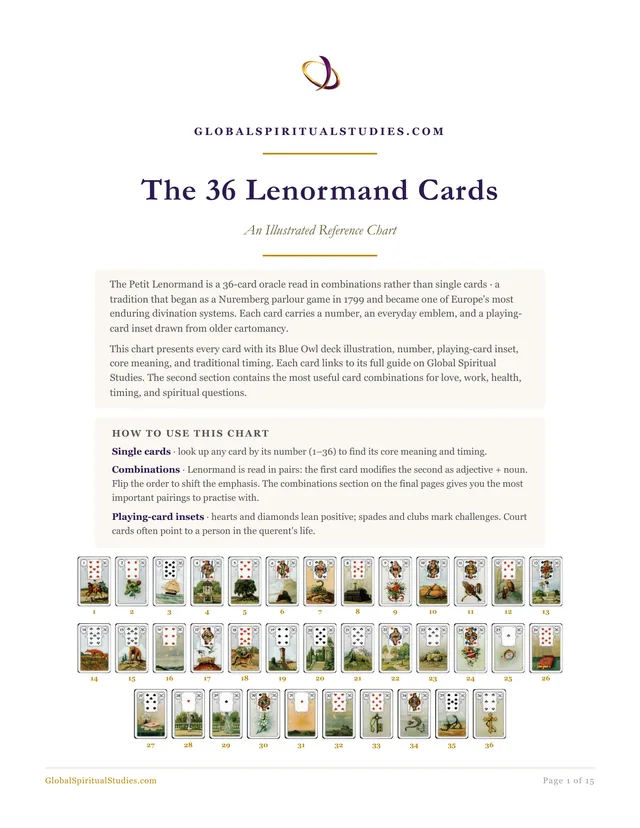
Whether this pair describes a closure or a frozen account usually comes down to the card that follows it. Our free 36-card Lenormand chart sets every card's meaning, polarity and timing on one printable page, which makes that check quick.
Coffin + Fish
The ending leads and the Fish says what is closing
Coffin first makes the ending the noun. The Fish then supplies the adjective, and the adjective is commercial: this is an ending of a financial kind. The sentence the pair makes is that something is closing and it is money-shaped. A shop shutting its doors, an account being wound up, a contract that stops paying, a client who does not renew.
What this order fixes is the event. Something does finish. What it leaves open is whether the finish was chosen. Retiring a business that has run its course and losing one that was meant to continue are both Coffin + Fish, and nothing in these two cards distinguishes a retirement from a collapse. A Key or a Scythe after the pair pushes it towards decision; Mice or the Cross push it towards attrition and burden.
Lisa Boswell's entry for this order is mostly closures of exactly this sort: closed bank accounts, empty exchanges, forgotten resources. That last phrase deserves attention. A forgotten account is still an ending of a sort, and a far quieter one than ruin.
Picture a freelancer asking about a side business that has stopped paying its way. This order is the one that names the closure, and it is careful not to put a price on it.
Fish + Coffin
The money leads and the Coffin describes its condition
Reversed, the Fish becomes the subject and the Coffin describes it. The sentence is that the money is in a Coffin state, and a Coffin state is not only loss. It is stillness, a pause, something laid down. Funds that are frozen, an investment gone dormant, savings that simply are not moving, income on hold while some other matter is resolved.
This order also holds a reading the other cannot reach: money that comes out of an ending. If the Coffin is describing where the money came from, the pair gives an estate, a payout on a closure, a settlement at the end of a marriage or a job. Boswell files inheritance under this order and not the other, which fits the grammar exactly: the money is the subject, and the Coffin explains it.
That is the sharpest contrast on the page. Coffin + Fish says a financial thing has ended. Fish + Coffin reports on the state of the money, and that state can be stalled, spent, or newly released by a finish somewhere else. The neighbouring cards decide which.
A woman asking why a joint account from a dissolved partnership still has not been divided would meet this order. It describes the stoppage, and it leaves the reasons for the delay to the cards around it.
The pair across five areas of life
| Area | Coffin + Fish | Fish + Coffin |
|---|---|---|
| Love | A relationship with money woven through it reaching an end: shared property, a joint venture, accounts that now have to be separated. The ending is the event; the finances are what make it complicated. | Shared money at a standstill inside a relationship, or money released by an ending, such as the sale of a home two people once shared. The row describes arrangements, not feelings. |
| Work | A business, a contract or a line of income closing. Whether it was chosen or imposed comes from the next card along. | Revenue frozen or paused: a project on hold, a client who has stopped paying, an enterprise in a dormant phase rather than a dead one. |
| Money | An account closed, an income stopping, a venture wound up. The cards describe a closure and say nothing about its size, and where real figures are involved an independent professional perspective is the sensible companion to any reading. | Funds that are stuck, dormant or tied up, or money that arrives because something else has ended. Neither is a forecast of a windfall or a loss, only a description of where the money stands. |
| Health | The Coffin's illness register beside a card that in some lists includes drink, and Boswell's entry for this order mentions addiction. Read the row as circumstances around care, never as a diagnosis; anything medical belongs with a qualified practitioner. | Resources tied up during a period of rest, leave or recovery. The money is what this row describes, and the body is outside what two cards can speak to. |
| Timing | Here the Fish falls second, so it governs the pace, and its clock is commercial: the end of a quarter, a trading year, a renewal, with 34 units as a weak fallback. | With the Coffin in second place, the Coffin governs, and what it supplies is a pause rather than a count. The money moves once the ending it depends on has finished; 8 units sit behind that as a fallback and are rarely worth much. |
Coffin and Fish in the Grand Tableau
Side by side, the two cards make the sentences above, and whatever lies just past them usually settles whether the ending was chosen. Spread far apart, they stop making a sentence at all. Joining them into one story is the reader's choice, not the cards'.
The oldest text adds a twist that is easy to miss. On the 1846 sheet the Coffin is at its worst very near the person and grows less dangerous with distance. The Fishes run the other way: near, a fortune; far, a failed speculation. Place both cards close to the significator and their old entries collide, a total loss beside a large fortune. Place both far away and the Coffin softens just as the Fish turns sour. There is no placement in which both entries read kindly. The sheet gives no combinations, so that observation is ours, built from two separate entries rather than from any rule the sheet states.
The Coffin in house 34 puts an ending in the part of the tableau that answers questions about money and business: something is closing in the finances. The Fish in house 8 places money in the house of endings and rest, which most often describes funds connected to a closure, such as an estate being wound up, a final payment, or an account on pause. Both house readings are ours; no published placement for either was found.

Where the traditions differ
On the headline, the sources reviewed here agree: money ends. Underneath it they split three ways.
Loss and closure is the large group. Labyrinthos gives the loss of finances and of something valuable, and prints the same line on both cards' pages. Anna K reads giving up a business, losing money, or abandoning the idea of becoming rich, and her combination pages say plainly that she does not take card order into account. madame-lenormand.de lists money lost, business not running, a source of income drying up and a company closed, and in its love section a relationship with shared money that ends and then has to be settled. Our own Fish card page carries one line for this pair, filed under the Fish-first order: financial loss, the end of a revenue stream, a business closing. By the grammar on this page, that is a Coffin-first gloss under a Fish-first heading.
Inheritance is Boswell's, and she is precise about where it goes. Her Fish-first entry gives inheritances, businesses dying, and counting on someone or something to die. Her Coffin-first entry gives closed accounts, drowning, death from addictions, forgotten resources and empty exchanges. That split matches the one on this page: the money as subject when it comes out of an ending, the ending as subject when something closes. It is the only directional evidence in the survey, and it agrees with the method without having been derived from it.
Depth is the smallest branch. Andreas Roth, writing in German, gives heavy money worries reaching as far as insolvency, then adds that something previously unconscious can come to the surface. That reads card 34 as deep water rather than as a bank, and it gives the pair a second life outside finance that none of the English lists reviewed here offers.
Nothing here is attributed to Mary K. Greer or Caitlín Matthews, who teach for Global Spiritual Studies; neither has published a checkable entry for these two cards together. The 1846 sheet contains no combinations at all. Its separate entries for the Coffin and the Fishes are quoted above, and anything built by setting them side by side is our reading.
A reading in three cards
A man who has run a small online shop for six years asks what is happening with it. The line comes out Coffin · Fish · Stork.
An ending leads, the Fish names it as commercial, and the Stork carries the sentence into change. Read together: the shop as it stands is closing, and the closure belongs to a move towards something else. The line does not say whether the move is better or worse, and it does not say whether the closing was his decision. It describes a commercial ending that opens onto a transition.
Swap the first two. Fish · Coffin · Stork makes the money the subject: the shop's income is at a standstill, and the Stork says the standstill will not stay put. That describes a pause, not a closure. Same three cards, and one reading has the shop finished while the other has it waiting.
What readers get wrong about this pair
Assuming the closure was done to the querent. The Coffin covers deliberate endings and rest as readily as losses, and a business wound down on purpose is still Coffin + Fish. Whose decision it was is a question for the cards on either side.
Taking Boswell's darkest glosses literally. Drowning and death from addictions sit in her Coffin-first entry. They are images from the far edge of the card's range, and beside most neighbours this order describes accounts and shopfronts, not bodies.
Forgetting that a frozen account is not an empty one. Fish + Coffin very often describes money that exists but is not moving: held up in probate, tied up in a dispute, parked somewhere dormant. Treating stillness as loss turns a waiting reading into a grieving one.
Letting the Fish's polarity cancel the Coffin. Card 34 is positive in most traditional references, and some readers hope that a positive card in the pair means the loss will be made good. It does not work that way within this method. The Fish is describing what kind of ending this is, or it is the thing in a stopped state; in neither role does it reverse the Coffin. Recovery, if the spread holds one, arrives with a third card such as the Sun, the Key or the Stars.
Hearing only money in card 34. Depth, independence and emotional undercurrents sit in the Fish's range too. Next to people cards rather than business cards, the pair can describe the end of a spell of self-employment, or a feeling that has gone quiet below the surface.
Questions about Coffin and Fish
What does the Coffin and Fish combination mean in Lenormand?
It describes something financial at an end, and the order says which part. When the Coffin leads, the ending carries the reading and the Fish makes it commercial: a business closing, an account shut, an income that stops. When the Fish leads, the money carries the reading and the Coffin describes its state, which can mean funds frozen or dormant, or money that arrives because something else has finished.
Does the Coffin and Fish combination mean bankruptcy?
Not on its own. The pair describes a financial ending without any measure of its size, and a closed account or a retired side business fits it as well as a collapse does. Andreas Roth's German entry does reach as far as insolvency, but that is one reading at the far end of the range. Anyone weighing real decisions about debts or a business may want an independent professional perspective, which two cards cannot supply.
Can the Coffin and Fish combination mean an inheritance?
Yes, and it belongs with the Fish in front. Lisa Boswell lists inheritances under that order, and the grammar explains why: the money is the subject and the Coffin describes how it comes, which is out of an ending. An estate is one such ending. A settlement or a final payment is another, and the pair predicts nobody's death.
Is the Coffin and Fish combination a yes or a no?
With the Coffin leading it is a no, since the thing being described is a closure. With the Fish leading it is a qualified no: the money is stuck or spent, unless the question was about funds released by an ending, in which case the Coffin is the source rather than the obstacle.
How long does the Coffin and Fish combination take?
The second card sets the pace. Coffin + Fish ends on the Fish, so the closure tends to keep business time, such as the end of a quarter or a financial year. Fish + Coffin finishes on card 8, and what that card offers is a halt rather than a date: the money waits until whatever ending it depends on has run its course.
Related combinations
Any other pair in the deck can be looked up in our Lenormand card combinations finder.
A pair like this turns on whether the ending was chosen, and that is read from the neighbours rather than from the two cards. The Complete Lenormand teaches lines, houses and the Grand Tableau together, so that a financial reading stays a description and never hardens into a verdict.