Mice and Fish
Mice and Fish is the deck's picture of money being worn away, and the two orders describe two different things that are easy to confuse in a reading. With the Mice in front, the wearing-away is the subject and the Fish names what is being consumed: an income, a business, a flow of resources. With the Fish in front, the money is the subject and the Mice describe its condition, which covers a fortune actually shrinking and a fortune that only feels precarious. Eighteen published entries were examined for this page, and not one separates the two directions, so the distinction below is ours rather than inherited.
- Mice + Fish (23 + 34)
- Erosion is the subject and the Fish says what is eroding. Money, trade or an income described as being consumed, usually gradually and usually without anyone watching it happen.
- Fish + Mice (34 + 23)
- Money is the subject and the Mice describe its state: diminishing, leaking, or weighed on by anxiety. This order is the one that can describe worry rather than an actual shortfall.
- The cards
- Mice · card 23 · 7 of Clubs · negative. Fish · card 34 · King of Diamonds · positive in most references, neutral in one.
- Yes or no
- Undetermined in both orders, and no source reviewed here offers one. The pair describes a direction of travel rather than an event, and a direction is not an answer.
- Timing
- Timing is taken from the second card, not the first. Mice + Fish ends on the Fish, whose interval is itself unsettled: a month or a season in some references, business cycles in others, and no time indicator at all in one. Fish + Mice ends on the Mice, and one German reference holds that this card does not supply a period so much as shorten whatever period the other cards gave.
The two cards
The Mice, card 23, split along a line that runs between languages. English keyword lists lead with attrition: dwindling, depletion, deficiency, decay. The most widely read English reference carries seven keywords for this card and not one of them is theft. German lists lead the other way, with three of the five reviewed here opening on Verlust and Diebstahl, loss and thieving. Both are the same card, and a reader who has only met one of them will read this pair with a confidence the field does not support.
The Fish, card 34, is not only money, though the combination lists treat it as though it were. Its keyword sets also carry independence and self-employment, deep water and emotional depth, value in the non-financial sense, and, in older German practice, drink: one German card page lists alcohol among the Fish's core meanings alongside tears, and another glosses the card's shadow as addictive behaviour. If card 34 is not always a bank balance, then this pair is not always about one.
In the directional method used on this site, we read the first card as the subject and the second as its modifier. On this pair the method is doing work nobody else has published, so the two readings below are presented as ours and the field's silence is reported rather than glossed over. That grammar is taught from the ground up in our Lenormand card guide.
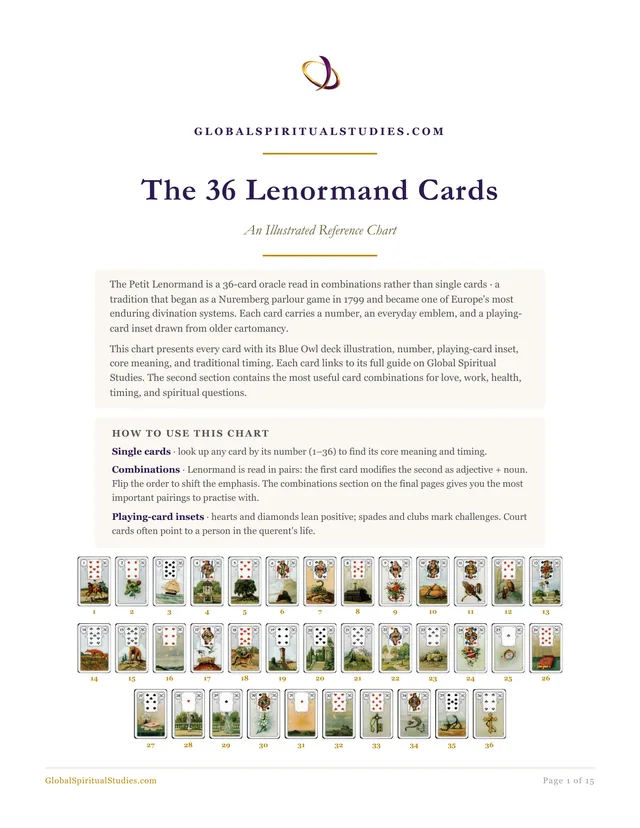
Whether this pair is describing a loss or a fear of one is settled by the cards around it, not by the two themselves. Our free 36-card Lenormand chart puts all thirty-six cards, their keywords and their timing on one printable sheet, so the neighbours can be read properly rather than guessed at.
Mice + Fish
The erosion is the subject and the Fish says what is being consumed
Mice first makes the wearing-away the thing under discussion, and the Fish identifies the area of life involved. The plain sentence is something is being consumed, and the something is money. That covers small persistent outgoings, a margin thinning year on year, subscriptions and fees nobody has looked at, and a trade quietly losing value while its owner is busy.
What this order does not carry is an amount, a cause or a culprit. The Mice describe a process, not an event, and the process they describe is gradual by definition. A reading that converts this order into a shortfall has added arithmetic the cards did not supply, and one that converts it into theft has chosen between two traditions without saying so.
This is the order for a question about where the money goes, asked by somebody who genuinely cannot see it leaving.
Fish + Mice
The money is the subject and the Mice describe its condition
Reversed, the Fish takes the leading position and the Mice become a description attached to it. The sentence is the money is in a poor state, and that is not a restatement of the order above. There, something was actively being consumed. Here, a condition is being reported, and a condition can be a shrinking balance or it can be a person's relationship with a balance that has not moved.
That second reading is almost unoccupied ground. Twelve of the eighteen entries reviewed for this page treat the loss as a material fact, and exactly one says plainly what a great many readings are actually about: having a good deal and still believing it is not enough. Another writer names investing in something that only produces anxiety. Card 23 carries stress and worry as prominently as it carries depletion, and beside the money card that gives a description of financial fear rather than of financial loss.
This order suits a question from someone whose accounts have not changed and whose sleep has.
The pair across five areas of life
| Area | Mice + Fish | Fish + Mice |
|---|---|---|
| Love | Neither card is romantic, so this row is usually money inside a relationship: shared costs quietly rising, or one person's resources going somewhere the other cannot see. It reports a strain, not a verdict on the couple. | The financial dimension of a partnership described as anxious. Frequently a reading about two people who disagree about how worried to be rather than about how much there is. |
| Work | A trade, a business or a role losing value incrementally. Margins, hours, clients or standing being nibbled at. The pair names the direction and leaves the size of it to the neighbouring cards. | The business itself described as under strain, which includes strain that is felt more than it is measured. The Fish's independence register puts self-employment squarely in this row. |
| Money | Resources being consumed gradually. The cards describe a movement and never a sum, a date or a cause, and any decision that turns on real figures is worth taking to an independent professional rather than to a card. | Finances described as diminishing or as worrying, and the pair does not distinguish between the two. That ambiguity is the honest content of this order and it is what the published entries reliably remove. |
| Health | Something being depleted, which in this pair is far more often a household budget than a body. Circumstances only; anything clinical belongs with a qualified professional and not with a keyword list. | Worry as the thing being described. One German reference reads the Fish's own shadow as addictive behaviour, and a reader who meets that here is looking at a circumstance, not making an assessment of anybody. |
| Timing | The Fish sits second and holds the pace, and its own interval is contested: a month or a season in some references, business cycles in others, and one source states outright that card 34 traditionally carries no time indicator. | The Mice sit second and hold the pace, and one German reference gives them a function rather than a duration, holding that this card shortens whatever period the surrounding time cards supplied. Read as a compression of the line's timing instead of a number. |
Mice and Fish in the Grand Tableau
The houses have nothing on file for either card here, so the two readings below are ours. The Fish in house 23, where the tableau asks what is being lost, gives the most literal answer available: the thing being lost is money. The Mice in house 34, where the question is how the money is, reports the finances as thinning rather than as gone, which is a milder statement than the same two cards make side by side and a more common one in practice.
The houses themselves are less agreed than they look. One published system gives house 23 as worries and undermining factors, which lines up with the card. Another gives house 23 as the lover, the person close to you in friendship and affection, which does not line up with anything and produces an entirely different tableau from the same layout. Naming that disagreement is more use than averaging it away, since a reader working from one list will get answers a reader working from the other cannot reproduce.

Where the traditions differ
On direction, the field is not divided. It is silent. Of eleven English references carrying a gloss for this pair, none gives the two orders different readings. Of seven German references, one does, and it does not help: Stregato splits them on a piece of German slang, since Mäuse is colloquial German for cash, which makes his Mice-first entry mean having plenty of money and inverts the polarity of every other entry in the field. It also contradicts the directional rule stated elsewhere on his own site. This is the only published attempt at the question, and it is a pun.
The pun crossed into English and lost its joke. One English-language reference ends its entry for this pair with a flat statement that money is not important, which is a straight translation of the German idiom with the wordplay stripped out. A reader meeting it in English has no way to know it was ever funny, and no way to know it is not a reading.
Erosion or theft is a real split and it runs along the language border. Nine of the eighteen entries reviewed here are erosion-dominant and seven carry theft or fraud. The English default is attrition, the German default is thieving, and three sources hold both at once. Two go as far as a con: one narrates the pair as somebody being talked out of everything they had, and another gives money earned dishonestly and bribery. Those are not stronger versions of the same claim. Attrition has no villain in it and fraud has nothing but.
The anxiety reading is nearly vacant. Stress and worry sit in the Mice's own keyword lists on at least nine sources across both languages, and one well-known writer states that stress is the commonest reading of the card. Carried into this combination, that would give a description of financial fear. Six of eighteen entries gesture at it, one states it cleanly, and the remaining twelve treat the loss as an accomplished fact. It is the most useful thing this pair can say and the thing it is least often allowed to say.
One entry runs backwards and nobody has noticed. A single English site glosses the combination as compensation for financial loss, which is money arriving rather than leaving, and gives no indication that it is departing from every other source in the survey. Two of the more fluent sites in this field publish uniform per-combination prose across all thirty-six cards with no sourcing of any kind, which is worth bearing in mind before treating agreement between them as corroboration.
The historical layer inverts the modern reading. The board this deck grew out of puts the outflow on the money card: the Fish square charges two marks on arrival. Card 23 carries no rule at all in the main sequence and appears only in an optional list of squares a party may declare as forfeits if it wants more variety. So the original object puts the outflow on the money card and leaves the mouse inert, which is a neat rhyme for a page arguing that this pair is really about the Fish. It is game mechanics rather than divination, since that leaflet contains no card meanings whatsoever, and it is quoted here for the shape rather than for the doctrine.
A reading in three cards
A man asks why money feels precarious when nothing in his accounts has actually changed. The line comes out Fish · Mice · Moon.
Money leads, the Mice describe its condition, and the Moon says that condition is being felt rather than shown. As one sentence: the finances are being experienced as thin. Nothing in the line reports a sum leaving, and on the question he asked that absence is the answer. The reading describes a state of mind about money, which is a real thing for a spread to be reporting and is not the same as a shortfall.
Move the Mice to the front. Mice · Fish · Moon puts the erosion in the subject position, so something genuinely is being consumed and the Moon reports that it is also weighing on him. The first line describes a fear. The second describes a loss that has a fear attached to it. Two cards cannot tell the difference between those; three can begin to.
What readers get wrong about this pair
Turning a direction of travel into a forecast. The pair names no amount, no date and no cause, and several of the pages ranking for it issue instructions about somebody's finances anyway, one of them telling readers to make an urgent plan. Cards describe circumstances; they do not undertake outcomes, and a reading of two cards is a poor foundation for a decision that has real money in it.
Assuming the money has already gone. Twelve of the eighteen entries reviewed treat the loss as a completed fact, and exactly one allows for the reading a great many querents actually need, which is somebody with enough who is convinced it is not enough. The cards do not distinguish between a balance falling and a person watching a balance.
Hearing only money in card 34. Independence, self-employment, emotional depth and, in older German lists, drink all sit in the Fish's own keywords, and one widely read English reference explicitly extends the card to value in the non-financial sense. An entry that reads all thirty-five of the Fish's pairings through a bank balance has narrowed the card before the reading starts.
Mistaking duplication for agreement. Two of the most visible sites print the identical sentence for this pair on both card pages, and one German site repeats its own gloss word for word across its two entries. A reader who conscientiously checks both orders on those sites collects one opinion twice.
Questions about Mice and Fish
Does the Mice and Fish combination mean financial loss?
It is what almost every published entry says, and the wording repays a second look. The pair describes resources being consumed or a financial position deteriorating, and it names no amount, no timescale and no cause. Whether that describes an actual shortfall, a slow leak somebody has not spotted, or a fear about money that the balance does not support is decided by the cards around it. Two cards report a direction and undertake no outcome, and anything with real money resting on it wants professional advice from somebody qualified to give it, not a two-card reading.
What is the difference between Mice + Fish and Fish + Mice?
Which of the two is being talked about. Mice first makes the erosion the topic and the Fish says what is eroding, so the reading is about a process consuming money. Fish first makes the money the topic and the Mice describe its condition, so the reading is about the state the finances are in, which can include a state of worry about finances that have not moved. None of the sources reviewed here separates the two directions, so this distinction follows from the method used on this site rather than from any tradition.
Can the Mice and Fish combination mean worry about money rather than actual loss?
Yes, and it is the reading the field most consistently leaves out. Stress and anxiety sit in card 23's own keyword lists on at least nine of the sources reviewed here, and one well-known writer says outright that stress is the commonest meaning of the Mice. Carried into this pair that gives financial fear rather than financial loss, and only one entry in eighteen states it plainly, describing somebody who has a great deal and still believes it is not enough. The Fish-first order is where it sits most naturally.
Is the Mice and Fish combination a yes or a no?
Undetermined in both orders, and unusually clearly so, because none of the eighteen entries reviewed for this page offers a yes or no at all. What the pair describes is a direction of travel rather than an event, and a direction cannot answer whether something happens. On a question about whether resources will hold it leans unhelpfully, but leaning is not a verdict, and whatever answer this pair gives comes from its neighbours.
How long does the Mice and Fish combination last?
The second of the two cards sets the pace, and neither of these is a reliable timekeeper. Mice + Fish ends on the Fish, whose published intervals range from a month or a season through business cycles to one source stating that card 34 traditionally has no time indicator. Fish + Mice ends on the Mice, and the field offers seconds to a week, one to five months, the 23rd day, and simply running out of time, with no page acknowledging the others. The most interesting position gives the card a function instead of a duration, holding that the Mice shorten whatever timescale the rest of the line supplied.
Related combinations
Browse the full Lenormand combination finder to look up any pair in the deck.
Learn Lenormand · explore our Lenormand courses with Mary K. Greer and Caitlín Matthews.
Money questions are where a memorised combination list does the most damage, because the entries sound certain and the cards are not. The Complete Lenormand teaches the method underneath them · subject and description, the neighbouring cards, the houses and the Grand Tableau · so a pair like this one produces a description of a situation rather than a prediction nobody can stand behind.