Book and Key
Book and Key is filed everywhere as the secret-revealed pair, and the older sources do not support the picture that phrase conjures. Lead with the Book and the hidden matter is the subject: it reaches a definite outcome, and the Key certifies that outcome without deciding which way it falls. Lead with the Key and the answer is the subject: a solution exists and the Book says where it is being kept, which is out of sight. These two orders sit closer together than most, for a reason worth knowing, and the place they separate cleanly is timing.
- Book + Key (26 + 33)
- The undisclosed matter reaches a certain conclusion. The research finishes, the qualification lands, the file closes, the secret settles. English lists assume it settles by coming out; German ones allow it to settle by staying in.
- Key + Book (33 + 26)
- The answer exists and has not surfaced. A decision, solution or piece of information is real, definite and currently held behind study, privacy or someone's discretion.
- The cards
- Book · card 26 · 10 of Diamonds · neutral. Key · card 33 · 8 of Diamonds · positive.
- Yes or no
- Book first is a yes to resolution: something concludes. Key first is undetermined, because an answer you cannot see cannot be scored yet.
- Timing
- The second card sets the pace, and this is where the two orders part company hardest. Book + Key lands on the Key, which most references treat as now, soon and certain, so a date becomes fixable. Key + Book lands on the Book, whose published timing is openly given as unknown, so the schedule dissolves rather than shortens.
The two cards
The Book, card 26, is the deck's container for what has not been disclosed: secrets, private matters, research, the unfinished course of study. It is one of the few cards whose picture is read as well as its number, since a volume drawn open and a volume drawn shut are saying different things. Ours is shut. The Blue Owl copy inspected for this page draws the book closed and clasped, with two ribbon markers still trailing from the fore-edge, which is a nice image of something already read by somebody and fastened again.
The Key, card 33, is usually introduced as unlocking, and its oldest recorded job is narrower and stranger than that. In the nineteenth-century instruction sheet the card is read by distance from the person and means the certain success of a matter close by, failure at a remove. There is no door in that entry and no lock. What the Key contributes is conviction rather than access, which is why it can sit beside almost anything and simply make it more definite.
In the directional method used on this site, we read the first card as the subject and the second as its modifier. Our Lenormand cards lays that out from first principles, and this pair is a good test of it, because one of the two cards behaves less like an adjective than like a stamp.
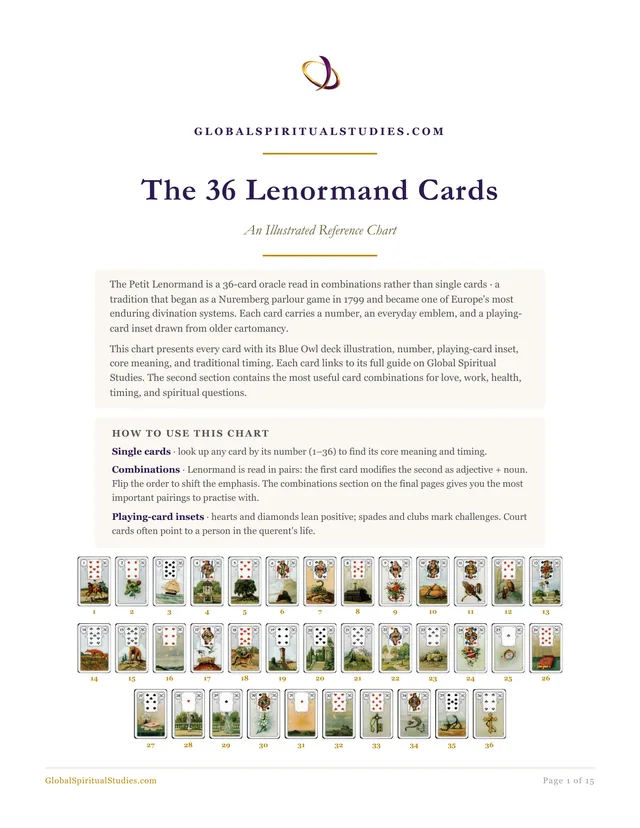
A pair that turns on whether certainty points inward or outward is one you want to read with the whole deck in view. Our free 36-card Lenormand chart gives all thirty-six cards, their inserts, polarity and timing on a single printable page, which makes the neighbours quick to weigh.
Book + Key
The hidden matter is the subject and it is made certain
Book first puts the undisclosed thing in the noun position and lets the Key qualify it. The sentence is this hidden matter is settled. A study reaches its end, an examination is passed, a piece of research yields, an investigation concludes, a private business stops being live. The Key is not prising the Book open in that sentence. It is signing off on it.
Which way the settlement falls is the part English lists supply for free and the sources do not. One well-known German card page carries both outcomes in a single entry: a secret that will certainly come to light, and equally something that can certainly be kept hidden and out of view. Another states plainly that the Key beside the Book means the secret is safe. So this order guarantees a conclusion, and the neighbours decide whether the conclusion is disclosure or a lid going on.
You would see it on a question about a long-running application, a course of treatment or a family matter that has been carefully not discussed. Something about it stops being open. What stops being open is not necessarily your access to it.
Key + Book
The answer is the subject and it is where you cannot see it
Reversed, the Key becomes the noun: the answer, the solution, the decisive fact. The Book then describes where that answer currently lives, and the Book's whole business is things not yet in view. The sentence is the answer exists and it is not available. Not that there is no answer. That the answer is behind something.
Honesty requires admitting how close these two readings run. Because the Key functions as a certainty rather than as a quality, applying it is nearly order-neutral, and that is precisely why so many lists print one sentence on both card pages and are not entirely wrong to. What changes with the order is not the certainty but what is being made certain: a conclusion in the first case, a concealment in the second. Emily Rose Divination is the clearest English source that separates them, giving success in studies for one direction and an answer not yet revealed for the other.
In practice this order turns up when somebody has already decided and has not announced it, when a result is known to a committee and not to you, or when the material that would settle the question exists and has not been read.
The pair across five areas of life
| Area | Book + Key | Key + Book |
|---|---|---|
| Love | Something unspoken between two people reaches a definite state. It may be said out loud; it may instead be settled privately and never mentioned again. | One person has reached a conclusion and is holding it. The feeling or the decision is real and the other party has not been told. |
| Work | A study, qualification, investigation or piece of research concludes. This is the direction that produces certificates, verdicts and closed files. | The decision has been taken upstairs and not circulated. Useful on questions about restructures, appointments and outcomes already known to somebody. |
| Money | A financial matter that was opaque is brought to a settled state, whether or not the detail is shared. Neither card names a sum. | The figure or the terms exist and have not been shown. The reading describes information withheld, and what to do about that belongs with the people involved and independent advice. |
| Health | A question that had no name reaches a definite answer. The pair describes the matter concluding rather than the outcome being good, and the reading says nothing medical, which is a matter for an independent professional perspective. | A result exists and has not reached the person waiting for it. Again a description of information, not of a body. |
| Timing | The Key falls second and therefore governs, and most references give it as now, soon and definite. A date can be fixed. | The Book falls second and therefore governs, and its published timing is candidly listed as unknown. No date is available, so describe the order of events instead. |
Book and Key in the Grand Tableau
One of the two house placements here is unusually well defined and the other is a blank, which is worth reporting rather than smoothing over. The Key in house 26, the position that asks what is hidden, is the answer that exists but has not yet been found, and that placement says the same thing as the Key-first order of the pair. For the Book in house 33, whose question is what the answer turns out to be, no established reading turned up in the sources reviewed. Reasoning from that question alone, a slot demanding resolution has been filled by the card of the undisclosed: the answer to the querent's central question is currently somebody's private business.
How much the Key does in a house is itself disputed. One tradition treats it as a guarantee, so that whatever house it lands in resolves. Lisa Boswell declines that reading and takes the Key as importance instead, marking the area of life demanding attention now without promising it works out. The two produce noticeably different Grand Tableaus from the same card.
Distance behaves as the older layer describes: the Key is stronger near the significator and weaker far from it, and at a distance some modern readers soften the traditional failure into mere delay. Far apart, the pair stops being a sentence and becomes two facts, a concealment in one part of the picture and a resolution in another, with no obligation to be about the same thing.

Where the traditions differ
The most useful disagreement about this pair is not about the pair. It is about what the Key does.
The Key does not open the Book in the primary sources. The nineteenth-century instruction sheet has the Book announcing a secret on its own account, with its position in the spread telling you how, and it has the Key meaning certain success near at hand and failure at a distance. Put those two entries side by side and the traditional composition is a secret coming to light with certainty, not a lock being picked. The unlocking image looks like a later reading back from the picture, and it is deck-dependent in a way the certainty reading is not: on a deck that draws the book already open there is nothing left for a key to do.
English says reveal, German allows conceal. Every English page reviewed for this page treats the pair as disclosure. Several German ones do not. One gives the Key as confirming that a secret is safe; another lists successful concealment in both directions; a third holds the two certainties together in one entry, so that the pair guarantees the outcome without specifying it. This branch has no English equivalent in the material surveyed here, and it is the single largest gap between the two literatures on these two cards.
Lisa Boswell reverses the directions. On her pages the disclosure language sits with Key first, diaries and revealing hidden information, while the study language sits with Book first. That is the opposite assignment to the one used above and to Emily Rose's. It is named here rather than quietly passed over: the field has not settled this, and the reading on this page is Global Spiritual Studies house interpretation resting on the grammar plus the timing evidence below.
The flattening is real but not universal. Of ten card-page pairs compared, three print the same string on both sides, one omits the pair from both pages entirely, and six give different text. The most-copied of the identical entries welds two incompatible predictions into one line, finding out the truth and education opening doors, and that same formula reappears near-verbatim on at least one other site, so its ubiquity is copying rather than consensus. One German reference states the underlying doctrine outright, that the order of most combinations is interchangeable.
Timing is where the sources nearly all agree, and it is the strongest evidence for reading the orders apart. The Book is given as an unknown timeframe by reference after reference, in both languages. The Key is given as now, soon, certain, and appears on published lists of fast cards. One outlier calls the Key long-lasting. Under the convention that the trailing card sets the pace, those two facts alone make Book + Key a pair that produces a date and Key + Book a pair that removes one.
A note on the oldest layer. In the board game the deck descends from, square 26 is not a schoolbook. It is a grimoire, and reading it triggers a hex that throws the player backwards to the garden at square 20. Square 33 pays two marks to anyone who reaches it, with no condition attached. Whatever else those rules are, they are not a lesson about education, and the schooling sense of the Book appears to be a later arrival.
A reading in three cards
A man asks whether an old family dispute will ever be explained to him. The line comes out Book · Key · Birds.
The hidden matter leads, the Key says it comes to a definite state, and the Birds put two voices around it. Read as one sentence: the private thing gets settled, and it gets settled in conversation. That is the disclosure reading, and note that it is the Birds supplying the disclosure rather than the Key.
Now swap the first two. Key · Book · Birds reads as an answer that exists and is being kept, with talk gathering around it. People discussing something nobody will confirm, which is a recognisable family weather system and a completely different thing to tell him. Three identical cards, one moved, and the gap between something being said and something being circled.
What readers get wrong about this pair
Believing the Key opens the Book. It is a good picture and it is not in the older text, where the Book discloses on its own and the Key certifies. Keeping the two jobs separate is what allows the pair to mean a secret definitely staying shut, which is a reading you lose entirely once the Key becomes a lockpick.
Taking certainty for disclosure. Certain and revealed are not the same word. The German branch uses the identical two cards to promise that something stays private, which is only startling if you have assumed the Key always points outward.
Reading a qualification into it automatically. The education sense of the Book is genuinely taught, particularly in German practice, where the pair can mean an important examination passed. It is also absent from the two oldest layers, where the card is a secret in one and a hex book in the other, so it is a sense rather than the sense.
Hearing the word "everything". Knowledge that unlocks everything is the standard gloss and it is a size claim the cards never make. The pair settles one matter. A reading that turns two cards into a life-changing revelation has promised something neither card is carrying.
Questions about Book and Key
Does the Book and Key combination mean a secret will be revealed?
Usually, and not necessarily. What the pair reliably says is that the undisclosed matter reaches a certain outcome. English references read that outcome as disclosure almost without exception, while several German ones allow the opposite, using the same two cards to confirm that something stays hidden. The Key supplies conviction rather than direction, so the surrounding cards are what tell you whether the lid is coming off or going on.
What is the difference between Book + Key and Key + Book?
What is being made certain. Book first puts the hidden matter in the subject position and certifies its conclusion, so the study finishes or the private business is settled. Key first puts the answer in the subject position and uses the Book to say where it is being kept, so a solution exists and is not available to you. The two run closer than most pairs, because a certainty is nearly order-neutral, and what separates them reliably is what each order does to a date.
Is the Book and Key combination a yes or a no?
Book first is a yes to resolution rather than a yes to the question: something concludes, and the pair does not say in whose favour. Key first is undetermined, since an answer nobody has shown you cannot be scored yet. Neither order is a no, because the Key is a positive card and the Book has no polarity of its own to push against it.
Does the Book and Key combination mean passing an exam?
It is a fair reading of the Book-first order and it comes from a particular tradition rather than from the cards' oldest layer. German practice carries the Book strongly as training and study, and at least one German reference glosses this pairing as an important examination passed. The two earliest sources know nothing of it: in the nineteenth-century sheet the Book is a secret, and in the board game the deck grew out of it is a book of spells that penalises whoever reads it.
How quickly does the Book and Key combination resolve?
Pace falls to the trailing card, and the answers point opposite ways, which is the best-sourced thing about this pair. Book + Key ends on the Key, listed across most references as now, soon and certain and named on published lists of fast cards, so a date can be given. Key + Book ends on the Book, whose timing is openly reported as unknown in both languages, so the sensible answer is a sequence rather than a day. One reference calls the Key long-lasting and stands alone in doing so.
Related combinations
Browse the full Lenormand combination finder to look up any pair in the deck.
Learn Lenormand · explore our Lenormand courses with Mary K. Greer and Caitlín Matthews.
Some cards describe and some cards qualify, and telling the two apart is what stops a pair like this one collapsing into a single sentence printed twice. The Complete Lenormand teaches the grammar alongside the houses and the Grand Tableau, so that the order of two cards keeps doing the work it is supposed to do.