What Is a Shamanic Drum Journey? A Stage-by-Stage Guide for Beginners
The intention, the posture, the drum and the rattle, the three worlds, the helping spirits, the callback, the return and the writing, as core shamanism teaches them
A shamanic drum journey is an inward journey taken with the eyes closed or covered, to a steady, rapid drumbeat. The journeyer sets a clear intention, travels to what core shamanism calls the Lower, Middle or Upper World to meet helping spirits, asks and listens, and is brought back by a change in the drumming called the callback.
This page is the Global Spiritual Studies reference on what a shamanic drum journey is, stage by stage. It is drawn from primary sources (the Foundation for Shamanic Studies and Michael Harner on core shamanism, Mircea Eliade's study of shamanism, and the 2014 PLoS One drumming study by Gingras, Pohler and Fitch), and where those sources disagree each view is shown and credited. Global Spiritual Studies teaches flower essences as a contemplative practice and makes no health claims. This page sets out the anatomy of a journey and the speed of the drum; how journeying compares with meditation is covered in Meditation and Shamanic Journey.
A note on how we teach this. Flower essences are presented here as a spiritual and contemplative practice. They are not a substitute for medical or psychological care, and nothing on this page is a health claim.
On this page
A drum journey, defined
The word journey is meant quite literally by the people who practice it. The body stays still, usually lying down or seated with the eyes covered, while the attention travels. The drum is what carries it. A steady, rapid, unchanging beat begins, the journeyer sets off with a purpose held in mind, and for the fifteen or thirty minutes of a typical recording the drum keeps going while the journeyer explores, meets, asks and listens. Then the beat changes, and the journeyer comes back.
A drum journey as core shamanism teaches it has eight parts, and they are the sections of this page: an intention fixed before the drum starts; a posture and setting that dim the outer world; the drum, or sometimes a rattle; a destination in one of three worlds; an encounter with helping spirits; the callback that ends the journey; the return to ordinary awareness; and a written record afterward. A beginner who understands those eight parts understands the practice, even before the first journey.
A drum journey is not the same as a guided visualization. In a guided visualization or a Kabbalistic pathworking, a voice or a script leads the imagery step by step. In a drum journey the drum says nothing. The intention gives the direction, and what is met along the way is not scripted.
Key terms
- Drum journey
- An inward journey taken with the eyes covered, to a steady, rapid drumbeat, with a set intention and a deliberate return (Foundation for Shamanic Studies).
- Callback
- The fast drum rhythm that closes a Foundation for Shamanic Studies journey recording and signals the return to ordinary awareness.
- Lower World
- In core shamanism, one of three worlds of nonordinary reality, with the Upper and Middle Worlds (Harner); the destination the Foundation for Shamanic Studies gives as its example.
- Helping spirit
- In core shamanism, a compassionate spirit met in the journey; one met in animal form is called a power animal (Harner; Foundation for Shamanic Studies).
Where it comes from
Drumming to travel in spirit is old and widespread. The historian of religion Mircea Eliade, in Shamanism: Archaic Techniques of Ecstasy (French 1951, English 1964), defined shamanism as a technique of ecstasy and described shamans who leave ordinary awareness to ascend to the sky or descend to the underworld. In his account of Central and North Asian practice the drum is one of the shaman's chief means of making that journey. Eliade's survey has been criticized, by the historian Ronald Hutton among others, for generalizing across very different peoples, but it remains the frame most writers start from.
The drum journey that most people in Europe and North America learn today comes from a narrower and more recent source: the American anthropologist Michael Harner (1929 to 2018). In The Way of the Shaman (1980), and through the Center for Shamanic Studies he founded in 1979 and the Foundation for Shamanic Studies that took over its work in 1987, Harner taught what he called core shamanism. It is a deliberately cross-cultural method, built from features he found shared across many shamanic cultures. The 2014 PLoS One study by Gingras, Pohler and Fitch calls it probably the best-known shamanistic method in Western practice.
That origin carries a caution. Core shamanism is not the tradition of any Indigenous people, and the Foundation itself says its principles are not bound to any specific cultural group. It has also been criticized as resting on cultural appropriation; the scholarship on both sides is summarized in Meditation and Shamanic Journey. What follows describes the method as Harner and the Foundation teach it, which is the form a beginner is most likely to meet in a book, a workshop or a recording.
The intention
Core shamanism puts the intention first. The Foundation for Shamanic Studies tells journeyers to be very clear about their journey intentions and about where they are going, giving the Lower World as an example, and to use a departure point chosen in advance. The intention is decided before the drum begins and held in mind as it starts.
An intention in this sense is short and specific. It names a destination and a purpose: to travel to the Lower World and meet a helping spirit, for example, or to return to a place visited before and ask a single question. A simple intention is easier to hold for the length of a journey, and easier to write about afterward.
One study suggests that what a listener is told beforehand matters. In the Gingras, Pohler and Fitch study, 39 participants with no experience of shamanic journeying listened for fifteen minutes to repetitive drumming or to instrumental meditation music, after hearing either shamanic journeying instructions or relaxation instructions. Those who heard the drumming with the journeying instructions reported a sense of heaviness and dreamlike experiences significantly more often, by their own account, than those who heard the same drumming with relaxation instructions. The drum was identical. What the listener had been asked to do was not.
Posture and setting
The setting is plain. The Foundation for Shamanic Studies asks the journeyer to sit or lie down in a quiet, dimly lit or dark room, and to cover the eyes with a bandanna or other piece of cloth to block out any light. Gingras and colleagues report that Harner recommended a specific position: lying on the back with the left hand covering the eyes.
The purpose of both instructions is the same. The outer world is dimmed so that the inner one has room. A darkened room, a covered face and a still body remove most of what would otherwise pull the attention back to the ordinary day. Lying down is common because it is the easiest posture to hold without effort for half an hour; sitting works for people who find that lying down makes them sleepy.
Beyond that, the practical needs are few: a time when you will not be interrupted, something to cover the eyes, a source of drumming, and a notebook and pen within reach for afterward.
The drum and the rattle
The journey drum is played in a steady, rapid, unchanging beat. The Foundation for Shamanic Studies is explicit that shamanic drumming is not music and is not meant for musical enjoyment or entertainment. Its job is to carry the journey: to give the attention a sound to follow and the journey a span of time to happen in.
How fast the beat should be is less settled than many pages suggest. The two most cited figures do not match, and the recording a well-known study used was faster than the figure that study gives:
| Source | Tempo given | In beats per minute | What kind of source |
|---|---|---|---|
| Foundation for Shamanic Studies | “approximately 5 beats per second” | About 300 | The organization Harner founded, describing its own journey drumming |
| Gingras, Pohler and Fitch, PLoS One (2014) | Harner's technique at “220 beats per minute”, a little less than 4 per second | 220 | A peer-reviewed study, describing Harner's method |
| The Harner drumming recording used in that study | About 4.2 beats per second | About 250 | Measured by the study's authors |
| Contemporary Western practitioners | A range of 4 to 7 per second, on drums or rattles | About 240 to 420 | A summary of typical practice in the same study, not a measured tempo |
| Foundation for Shamanic Studies, rattle | A steady rhythm of about 5 cycles per second | About 300 | The Foundation, listing the rattle as another instrument for journeying |
Sources: Foundation for Shamanic Studies, “Shamanic Drumming”; Gingras B, Pohler G, Fitch WT, PLoS One 2014;9(7):e102103. Beats per minute are converted from the per-second figures and rounded. Claims that a given tempo produces particular brainwaves are made by some practitioners and are not an established finding; this page makes no claim about what any tempo does. Full references are listed at the end of this page.
Where the sources agree is on the shape: a steady, rapid, repetitive beat, kept up without variation, then ended by a change. The exact speed matters less than its steadiness. A journeyer is not meant to listen to the drum as music, follow its changes or count it; the beat is meant to stay in the background, constant enough to be forgotten.
The rattle is the drum's most common alternative. The Foundation lists a rattle played in a steady rhythm of about five cycles a second as another instrument that can carry a journey, alongside a didjeridu with rhythmic click sticks, and the Gingras study notes that contemporary practitioners use drums or rattles. A rattle is quieter than a drum and small enough to shake for oneself, which some practitioners find useful when journeying alone without a recording.
Most beginners do not drum for themselves. Recorded journey drumming is widely available. The Foundation's own recordings come in 15-minute and 30-minute versions, on CD, as MP3 files and on streaming services, and both close with the callback described below. The Gingras study used fifteen-minute listening sessions, the length of the shorter Foundation recording. The guided journeys in the Global Spiritual Studies course Flower Essence Shamanism are recorded the same way, with the drum on the recording, so a quiet place, a notebook and a pen are all a journey needs.
The three worlds and helping spirits
Where does the journey go? In core shamanism the answer is a map with three levels. Harner called the place the journeyer travels nonordinary reality and divided it into the Lower World, the Upper World and the Middle World; the Foundation's introductory workshop describes journeys to explore other worlds and meet compassionate helping spirit teachers and power animals. The pattern echoes the ascents and descents Eliade described, though Harner presented it as a working method rather than as any one people's cosmology.
The Lower World is the usual first destination. The Foundation's drumming page gives it as its example of a journey's destination. The Upper World lies above and the Lower World below, while the Middle World is the nonordinary side of this one; Harner said that most journeying today goes to the Upper or Lower World, where the compassionate spirits are met. Each world is entered from the departure point fixed in the intention.
The purpose of traveling there is to meet compassionate helping spirits. In core shamanism many of these appear in animal form, and a helping spirit in animal form is called a power animal. The journeyer meets the spirit, asks the question the intention named, and listens. The answer may come as words, an image, a feeling, a gesture or a scene. Making sense of what came belongs to afterward, in the journal, rather than to the journey itself.
How helping spirits are understood varies. Some practitioners understand them as real, independent beings. Others see them as images arising from the journeyer's own depths. Others decline to decide. The method as the Foundation teaches it does not require the journeyer to settle the question before journeying, and a reference page cannot settle it either. What can be said is that the encounter, the asking and the listening are the heart of the practice, and the rest of the journey exists to make room for them.
The callback and the return
A drum journey ends with a signal. In core shamanism the signal is the drum itself: the Foundation for Shamanic Studies says its recorded journeys conclude with a fast callback rhythm to bring the journeyer back to ordinary reality. When the steady beat changes to the callback, the journeyer takes leave of where they are and comes back.
The return is part of the practice, not an afterthought. A journeyer who has been deep in an inner landscape for half an hour needs a moment before standing up, speaking or driving. It is sensible to stay still for a short while after the drum stops, to open the eyes slowly, and to notice the room, the body and the breath before moving. The point of the callback is to arrive back fully, not merely to stop.
A journey can also end early. If the journeyer wants to stop before the callback, opening the eyes ends it. Nothing in the method requires a journey to run to its full length.
Writing it down
The last stage happens on paper. The Foundation for Shamanic Studies advises journeyers to keep a journal of their experiences, and it helps to write soon after the return. Details fade quickly, the way dreams do, and what seemed vivid in the journey may be hard to recall an hour later.
The record does not need to be polished. A few lines will do: the intention, where the journey went, what was met, what was asked, what came back, and anything that did not make sense at the time. Over weeks and months a journal also shows patterns that no single journey reveals, which is why some practitioners keep one for years. Our guide to flower essence journaling describes one way of keeping such a record alongside a contemplative practice.
The parts of a drum journey, at a glance
| Stage | What happens |
|---|---|
| The intention | A clear purpose and destination, fixed before the drum begins, with a chosen departure point |
| Posture and setting | Sitting or lying down in a quiet, dim room, with the eyes covered |
| Going in | A steady, rapid drumbeat begins, or sometimes a rattle, at roughly 220 to 300 beats a minute |
| Traveling | The journeyer sets off for the Lower, Upper or Middle World of nonordinary reality |
| Meeting and asking | The journeyer meets a helping spirit, often a power animal, asks the question and listens |
| The callback | The drum changes to a fast callback rhythm |
| The return | The journeyer comes back to ordinary reality and opens the eyes |
| Writing it down | The experience is recorded in a journal |
Sources: Foundation for Shamanic Studies, “Shamanic Drumming” and its Way of the Shaman workshop page; Michael Harner, interviewed by Bonnie Horrigan; Gingras, Pohler and Fitch, PLoS One (2014). The table describes the form of the practice only and makes no claim about its effects. Full references are listed at the end of this page.
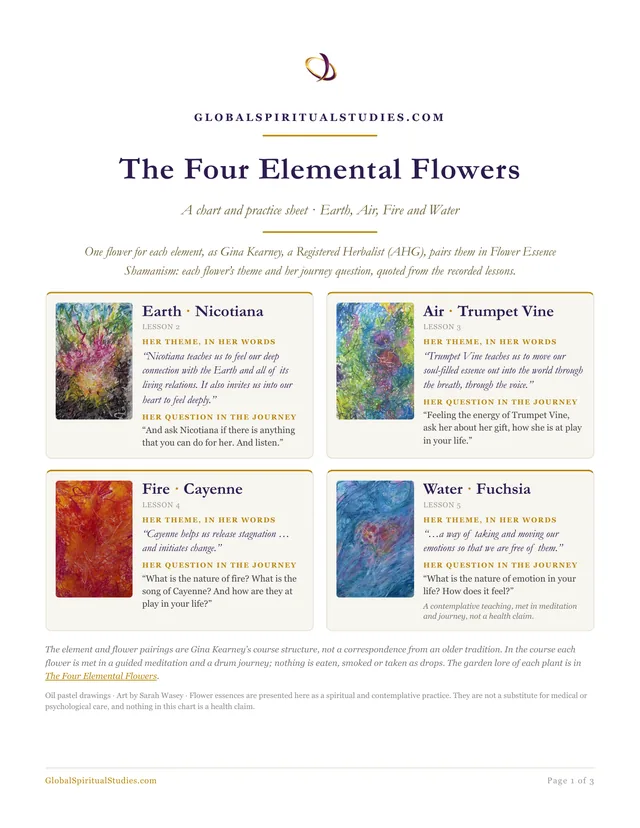
Free chart: The Four Elemental Flowers chart and practice sheet · four flowers, one for each element, with a practice arc from meditation into journey on a single page and a journal sheet for each element, as a printable PDF.
Before you begin
You can open your eyes at any time. If inward practices are difficult for you, talk with someone you trust first.
No special background is needed, and no drum of your own. A first journey may bring vivid images, only a feeling, or very little, and none of those is a failure. Like meditation, journeying is a practice: the second and tenth journeys are rarely like the first, and the skill that improves most with time is the simplest one, holding an intention steadily while the drum carries you.
 Online course · Gina Kearney, RH (AHG) Flower Essence Shamanism · Meeting the Four Elemental Flowers Six recorded lessons. An introduction to flower essences and to a practice of meditation and journey, then one guided meditation and drum journey for each of four flowers: Nicotiana for Earth, Trumpet Vine for Air, Cayenne for Fire and Fuchsia for Water. The drum is on the recordings. Explore the practice → What's included
- Six recorded lessonsover 2½ hours of teaching and practice
- Four guided journeysa meditation and drum journey for each flower
- PDF handouts and flower cardssix lesson handouts, four printable cards
- Two live sessions with Ginaa live Q&A and a fifth-flower practice, both recorded
- Final quiz and certificatea certificate of completion in your name
- Captions on every lessonEnglish now, translations coming soon
Sources & Tradition7 references
- Gina Kearney is quoted verbatim from the recorded lessons of Flower Essence Shamanism (Global Spiritual Studies, 2026), Lesson 2 and Lesson 4.
- Foundation for Shamanic Studies, “Shamanic Drumming” (setting, intention, tempo, rattle, callback, recordings, journal) · shamanism.org
- Foundation for Shamanic Studies, “Core Shamanism” · shamanism.org · and “The Way of the Shaman” workshop (other worlds; helping spirit teachers and power animals) · shamanism.org
- Michael Harner, interviewed by Bonnie Horrigan (the Upper, Lower and Middle Worlds; helping spirits; nonordinary reality) · Foundation for Shamanic Studies
- Foundation for Shamanic Studies, “In Memoriam: Michael J. Harner (1929 to 2018)” · shamanism.org · and Michael Harner, The Way of the Shaman (1980) · overview at wikipedia.org
- Mircea Eliade, Shamanism: Archaic Techniques of Ecstasy (Princeton University Press, 1964; French original, Payot, 1951) · overview and reception at wikipedia.org
- Gingras B, Pohler G, Fitch WT. “Exploring Shamanic Journeying: Repetitive Drumming with Shamanic Instructions Induces Specific Subjective Experiences but No Larger Cortisol Decrease than Instrumental Meditation Music.” PLoS One 2014;9(7):e102103 · PMC
Frequently asked questions
What is a shamanic drum journey?
A shamanic drum journey is an inward journey taken with the eyes closed or covered, to the sound of a steady, rapid drumbeat. The journeyer sets a clear intention, travels to the Lower, Middle or Upper World of what core shamanism calls nonordinary reality, meets helping spirits, asks and listens, and is brought back by a fast callback rhythm. Much of the drum journeying taught in the West today draws on the core shamanism of the anthropologist Michael Harner and the Foundation for Shamanic Studies.
What is the drum for in a shamanic journey?
The Foundation for Shamanic Studies says shamanic drumming is not music and is not intended for musical enjoyment or entertainment; it is there to support the journey. In practice the steady beat gives the attention a sound to follow and the journey a span of time to happen in, and a change in the drumming signals the return. Claims that the beat changes brain activity are made by some practitioners; Global Spiritual Studies does not make them.
How fast is the drumbeat in a shamanic journey?
Sources differ. The Foundation for Shamanic Studies describes a steady rhythm at approximately five beats per second, about 300 a minute. A 2014 study by Gingras, Pohler and Fitch in PLoS One describes Michael Harner's technique as 220 beats per minute, a little less than four beats per second, while the Harner recording the study used ran at about 250 beats per minute. The same study reports that contemporary Western practitioners use a range of four to seven beats per second.
Why is a rattle sometimes used instead of a drum?
The Foundation for Shamanic Studies lists the rattle, played in a steady rhythm of about five cycles a second, as another instrument that can carry a journey, alongside a didjeridu with rhythmic click sticks. A rattle is quieter than a drum and small enough to shake for oneself, which some practitioners find useful when journeying alone without a recording.
How does a drum journey end?
In core shamanism the drum signals the end: the Foundation for Shamanic Studies says its recorded journeys conclude with a fast callback rhythm to bring the journeyer back to ordinary reality. The journeyer returns, opens the eyes slowly and, as the Foundation advises, keeps a journal of the experience. A journey can also be ended at any time by opening the eyes.
Continue reading
- Flower Essences · a complete guide · making, history, traditions and practice
- Meditation and shamanic journey · how the two practices differ and where they meet
- Plant spirit communication · asking, listening and giving back
- The Four Elemental Flowers · Nicotiana, Trumpet Vine, Cayenne and Fuchsia
An intention, a drum, a question, and the way back.