The Sun
The Sun is a trump card from the Visconti-Sforza tarot (c. 1450), one of the oldest surviving tarot decks in the world. Painted for the Duke of Milan’s court, this card depicts a nude putto holding a radiant sun and represents clarity, joy, and illumination.
A fat-cheeked child lifts a sun over his head, and the whole card seems to weigh nothing.
There are no twin children playing in a walled garden · that is the Tarot de Marseille. There is no boy on a white horse with a red banner against a wall of sunflowers · that is Pamela Colman Smith in 1909. The Visconti-Sforza Il Sole, Trump XIX, is earlier and simpler than either: a single nude putto, the chubby cherubic child that returned to Italian art with the rediscovery of the Roman spiritelli, standing on a low mound and holding aloft with both hands a large radiant sun-disk with a calm human face at its centre.
It is not a Bembo card. It is one of the deck’s later restored trumps, supplied by a second hand · the same later hand responsible for the Fortitude and Temperance restorations. Modern scholarship attributes that hand to Franco dei Russi and dates it to roughly c. 1465-70; the older, long-repeated ascription to Antonio Cicognara rests on a nineteenth-century literary forgery and is rejected today (Moakley; Kaplan; Dummett questioned it). The looser drawing, the softer flesh, the different gold tooling all place it a generation after Bembo’s original campaign.
And of all the trumps, this is the one most loaded with dynastic charge. The Sforza had taken a radiant sun · the raza ducale · as a house device, worn on clothing, painted through the Castello Sforzesco, illuminated in their manuscripts. A restored Sun holds aloft, at once, the cosmic sun, the Sol Invictus of antiquity, and the private emblem of the family that commissioned the deck. The putto is carrying the sun · and the house of Sforza is in it.
The Card
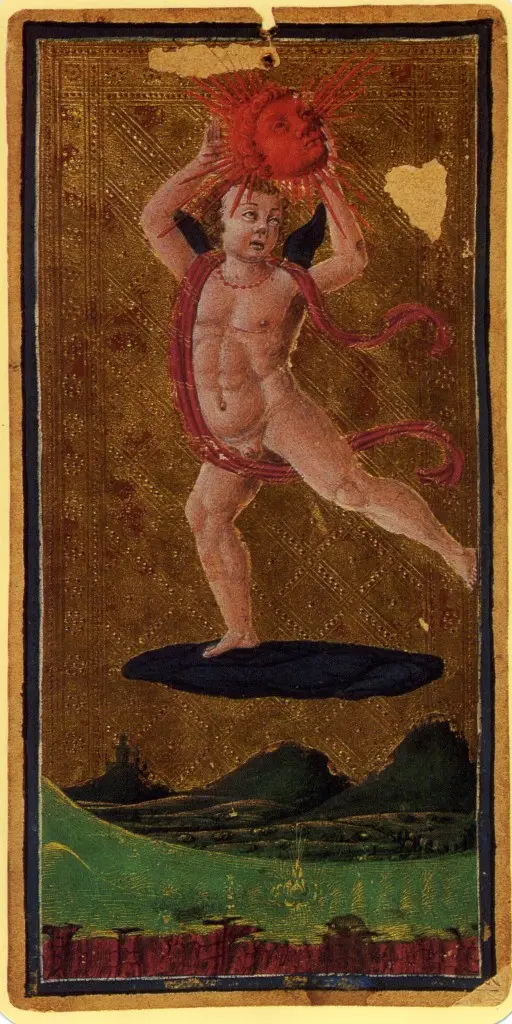
| Attribute | Detail |
|---|---|
| Period Name | Il Sole |
| Modern Equivalent | The Sun |
| Number | XIX |
| Type | Major Arcana (Trump) |
| Suit | Trumps (Trionfi) |
| Status | Surviving |
| Collection | Pierpont Morgan-Bergamo deck |
| Artist | Franco dei Russi |
Iconographic Analysis
Il Sole, Trump XIX of the Visconti-Sforza deck (Pierpont Morgan Library, MS M.630), is one of the deck’s later restored trumps. It is not by Bembo. Modern scholarship attributes the restoration hand to Franco dei Russi (c. 1465-70); the once-standard ascription to Antonio Cicognara is discredited, resting on a nineteenth-century literary forgery rejected by Moakley and Kaplan (Dummett questioned it). The style markers are unmistakable to the trained eye: looser late-quattrocento drawing, a different handling of flesh and drapery, a different facial type, and a slightly different gold-ground tooling. Fortitude and Temperance in the same deck share these markers and are attributed to the same hand.
The figure is a single nude putto · a chubby, cherubic child of the kind that returned to Italian art with the rediscovery of Roman spiritelli in the early and middle quattrocento. The putto stands or strides on a small mound at the lower edge of the card, holding aloft with both hands a large radiant sun-disk. The sun shows a human face at its centre, surrounded by alternating straight and wavy rays in the conventional Italian Renaissance solar diagram; the face is calm, frontal, and masculine. The putto itself is the iconographic centre of the card as much as the sun: his pose carries the slight contrapposto of a confident classical child-figure, his body unidealized in its baby-fat softness but classically poised in its stance, his head slightly turned.
This is not the Marseille Sun, which shows two children playing or embracing within a low walled enclosure beneath a face-bearing sun · an image of fraternal concordia moralized in later French and English systems. Nor is it the Rider-Waite-Smith Sun, where Pamela Colman Smith painted a single naked child crowned with a feather, mounted on a white horse, raising a red banner against a wall of sunflowers. The restored Visconti-Sforza image is earlier and simpler than both: one putto, one sun, one gold ground. Reference traditions stand clearly behind it · the classical and Renaissance putto / spiritello tradition, vigorous in Lombardy in the later quattrocento through Donatello’s bronze putti and the cherubic figures soon to adorn the Certosa di Pavia; Sol Invictus iconography from late antique coinage; and the Petrarchan Triumph of the Sun in trionfi manuscript illumination. Apollo-as-sun imagery was newly fashionable in humanist court art.
For students who feel drawn to the cards’ older imagery, Mary K. Greer’s Improve Your Tarot Readings Through Tarot History offers a deeper path into tarot’s evolution · from the courts of Milan to the Golden Dawn and beyond.
The Visconti-Sforza Court Connection
The dynastic charge of the Sun card in the Sforza milieu is exceptional. Galeazzo Maria Sforza (r. 1466-1476) adopted as a personal device the raza ducale · sometimes called the razza Sforza · a radiant sun, alone or paired with the biscione, used on his clothing, on harness and saddle, in palace decoration at the Castello Sforzesco, and in illuminated manuscripts produced for his court. The motif is documented in chronicles and in extant manuscripts and decorative cycles, and the sun device continued in dynastic use across the later fifteenth century.
A restored Sun trump painted by the later hand therefore lands within the long period of the Sforza sun-emblem’s dynastic deployment, and the image would have read as dense with personal-imperial resonance regardless of the precise year or patron of the restoration · which is not securely documented (the older confident narrative tying it to a specific 1480s regency was bound up with the now-rejected Cicognara attribution and is best treated with caution). Robert Place and Mary K. Greer have both noted that the Sun card in early Italian decks carries a more explicit dynastic charge than its later occult descendants. The restored putto holds aloft what is simultaneously the cosmic sun, the Sol Invictus of antiquity, and a recognizable Sforza family device · and as the highest of the three lights it stands immediately before the eschatological cards of Judgment and the World.
Artistic Technique and Condition
Restoration hand, attributed to Franco dei Russi, c. 1465-70 · egg tempera and gold leaf on paste-board. The technical markers align with Fortitude and Temperance in the same deck: a different tooling vocabulary than Bembo’s, softer flesh modeling, a thinner application of glazes, and a slightly drier handling of gold. The radiant sun-disk is built through incising and punching of the gold ground combined with a painted central face · a formula common in fifteenth-century North Italian solar emblems on devotional and secular objects alike. (The once-cited Antonio Cicognara attribution for this hand is a discredited nineteenth-century literary-forgery ascription, rejected by Moakley and Kaplan.)
From Bembo to the Modern Tarot
The Sun’s iconographic journey moves from the solitary putto of the restored Visconti-Sforza card through the playing twin children of the Marseille trumps to the single solar child on horseback of the Rider-Waite-Smith deck. Each version reframes the relationship between the human figure and the solar disk, and each carries the visual idiom of its century · classical putto in fifteenth-century Lombardy, allegorical twin enfants in early modern French popular print, golden-age child-as-self in fin-de-siècle English esotericism.
The Marseille version, stabilized in the printed sheets of Lyon and Marseille by the early eighteenth century, presents two children, sometimes embracing, sometimes simply standing together, often within a low walled garden beneath a face-bearing sun · an image of concordia and shared joy read in occult commentaries as innocence and simplicity. Pamela Colman Smith’s 1909 Sun departs further still: one naked child crowned with a feather, mounted on a white horse, raising a red banner before a wall topped with sunflowers · a vivid Edwardian recasting of the trump as triumphant solar selfhood. The Golden Dawn assigned the Sun trump to the planetary Sun, the only trump where the literal celestial body matches the esoteric attribution, and Waite’s image responds to that congruence. Across all three versions the Sun retains its role as the bright, integrating, joyful card of the sequence. Robert Place has emphasized that few trumps preserve such consistent valence across so much iconographic change · the restored putto, the Marseille twins, and the Smith horseman do different things visually, but they all do solar things.
Frequently Asked Questions
Who painted the Visconti-Sforza Sun?
Not Bonifacio Bembo. The Sun is one of the deck’s later restored trumps · the same later hand responsible for Fortitude and Temperance. Modern scholarship attributes that hand to Franco dei Russi, c. 1465-70. The long-cited “Antonio Cicognara” attribution is discredited · it rests on a nineteenth-century literary forgery and is rejected by Moakley and Kaplan (Dummett questioned it).
Why is the Sun a restored card and not by Bembo?
The original Bembo Sun was lost, like several other cards. A second, later hand supplied a replacement to complete the deck. The Sun’s looser drawing, softer flesh modeling, and different gold tooling all date it a generation after Bembo’s c. 1450 campaign.
What is a putto, and why is one on the Sun card?
A putto is a chubby, cherubic child figure revived from Roman spiritelli during the quattrocento. The restored Sun shows a single nude putto holding a radiant sun-disk aloft · drawing on the classical putto tradition vigorous in Lombardy in the later quattrocento, on Sol Invictus imagery, and on the Petrarchan Triumph of the Sun.
What is the Sforza sun emblem, the raza ducale?
Galeazzo Maria Sforza adopted a radiant sun · the raza ducale, sometimes called the razza Sforza · as a personal device, used on his clothing, harness, palace decoration, and manuscripts. The restored Sun card would have read as dense with this dynastic resonance, holding the cosmic sun and the family emblem in a single image.
Why doesn’t the Visconti-Sforza Sun look like the Marseille or Rider-Waite-Smith Sun?
Because both later versions are subsequent reinventions. The Marseille Sun shows two children in a walled garden; Smith’s 1909 Sun shows a child on a white horse with a banner against sunflowers. The restored Visconti-Sforza card is earlier and simpler · one putto, one sun, one gold ground.
How does the Sun fit with the Star and Moon in the deck?
The Sun is the third and culminating member of the celestial trio · Star (XVII), Moon (XVIII), Sun (XIX) · the three lights that open the eschatological ascent of the trumps. As the highest light it stands immediately before Judgment and the World, and Mary K. Greer notes that the early Italian decks reward reading the celestial group as a single ascending movement.
This card appears in The Visconti-Sforza Tarot · Complete Illustrated Companion · a free 30-page PDF with all 78 cards. Download the companion →
Related Cards
The Sun is the third and culminating member of the celestial trio: The Moon (La Luna) in the Visconti-Sforza tarot and The Star (La Stella) in the Visconti-Sforza tarot complete the three lights of the heavens in the trump order, the ascent that opens the eschatological climb of the sequence. The World (Il Mondo) in the Visconti-Sforza tarot is the natural fourth term · the cosmic-eternal image that gathers the celestial lights into their final harmony, where the dance of the putto with his sun-disk resolves into the dance of the soul within the completed cosmos. Mary K. Greer has noted that in the earliest Italian decks the celestial-cosmic group should be read together rather than separately, as one continuous ascending movement toward the consummated order the deck pictures last.
Study This Card Further
The Sun is one of the most historically significant cards in the Western tarot tradition, and its story deepens when studied alongside the entire Visconti-Sforza deck. These courses offer guided paths through the history and iconography of the cards.
- Improve Your Tarot Readings Through Tarot History · Traces the tarot’s evolution from the courts of Milan through the Golden Dawn · Taught by Mary K. Greer
- Cartomancers in Western Art · The visual history of card reading across five centuries of Western art · Taught by Mary K. Greer
The Sun is part of our comprehensive Visconti-Sforza tarot guide, a card-by-card journey through Bonifacio Bembo’s fifteenth-century masterwork. Continue the series with The Last Judgment in the Visconti-Sforza tarot, or browse the complete Visconti-Sforza card index to explore the deck at your own pace.