Queen of Swords
The Queen of Swords is a Minor Arcana court card in the Suit of Swords, representing clarity, independence, and perception. She sees through pretense with unsentimental precision, valuing honesty and direct communication above comfort.
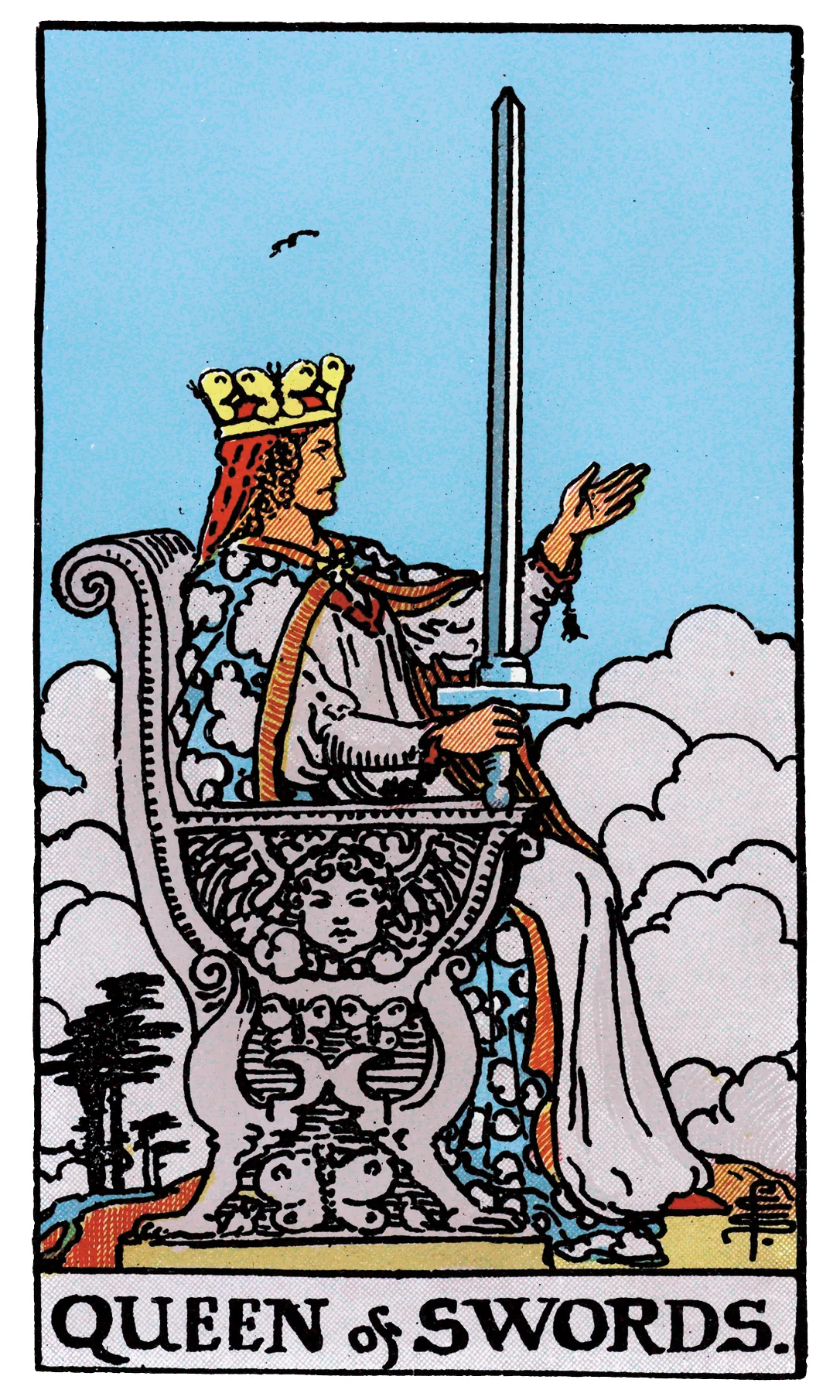
The Queen of Swords is the most perceptive figure in the court cards, a woman who has learned through experience that clarity is both her greatest gift and her most essential protection. In the Rider-Waite-Smith image, a Queen sits on a carved stone throne, her right hand holding an upright sword while her left hand is raised with palm outward. A single cherub adorns her throne, butterflies frame her crown, and gray clouds fill the sky behind her. Her expression is complex: watchful, intelligent, and bearing the weight of hard-won wisdom. This is not a woman who sees the world through rose-colored glasses. She has experienced loss, betrayal, or disappointment, and has emerged with her intellectual faculties sharpened rather than dulled. Water of Air gives the Queen her emotional depth concealed beneath mental precision. She feels as deeply as any Cups court card, but she processes those feelings through analysis rather than expression.
At a Glance
| Attribute | Detail |
|---|---|
| Suit | Swords |
| Traditional Names | RWS: Queen of Swords · TdM: Queen of Swords · Thoth: Queen of Swords |
| Element | Air |
| Zodiac / Planet | Water of Air · 21° Virgo to 20° Libra |
| Upright Keywords | clarity, independence, perception, direct communication, boundaries, experience |
| Reversed Keywords | coldness, cruelty, bitterness, manipulation, isolation |
Free printable chart: see the complete Minor Arcana chart · all 56 cards with upright and reversed meanings, suit, and element at a glance.
Visual Traditions: Three Decks
The Minor Arcana's imagery varies significantly across the three major traditions. Understanding these differences deepens your reading of any deck.
Rider-Waite-Smith (1909) · The image shown above.
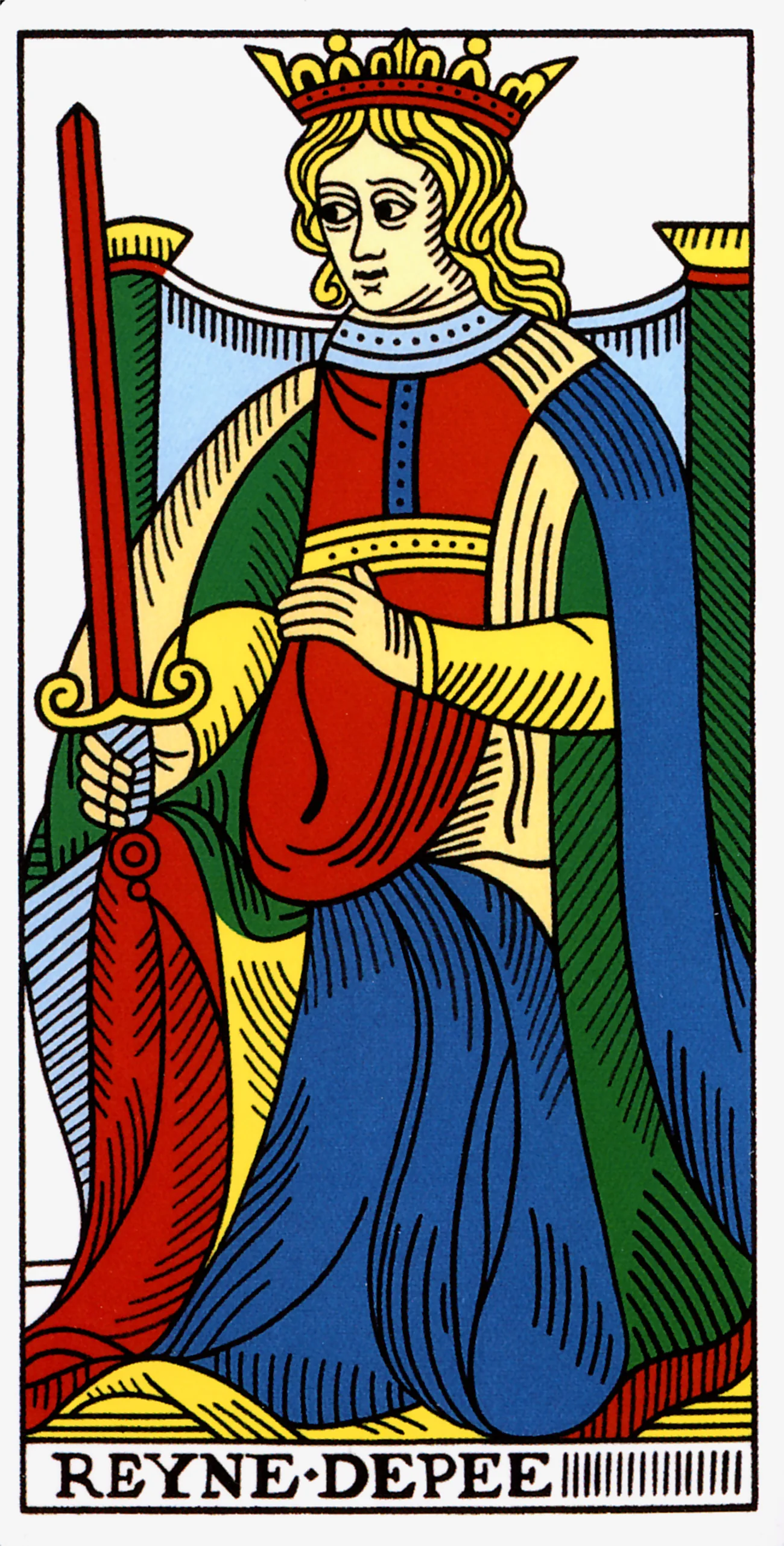
Tarot de Marseille (17th-18th century) · The Marseille Queen of Swords sits in a formal throne, holding an upright sword with composed authority. Her expression is neutral, her posture is dignified, and the overall impression is of institutional power exercised through intellectual means. Where the RWS Queen shows emotional complexity, a raised left hand suggesting grief or warning, the TdM Queen presents pure authority: the right to judge, decree, and decide. The formal, heraldic quality emphasizes the Queen's role as an embodiment of justice and discernment within a structured hierarchy.

Thoth Tarot (1943) · Crowley's Queen of Swords is a stern, regal figure seated upon a cloud throne, her sword held at an angle across her body. Her head is uncovered, and her expression is one of sharp, uncompromising assessment. A severed head rests in her left hand, representing the capacity to cut away falsehood and delusion without flinching. Harris painted the Queen with a cold beauty that conveys both admiration and warning: this is a mind of extraordinary clarity, but that clarity comes at the cost of emotional warmth. The Water-of-Air attribution creates a paradox: the emotional element expressed through the mental suit. The Queen feels deeply but processes everything through the filter of intellect, creating a personality that appears detached but is, in fact, intensely aware of emotional currents beneath the composed surface.
Key Imagery and Symbolism
The upright sword held firmly in the right hand signals clarity of mind, commitment to truth, and the capacity to make difficult decisions. The Queen does not wield this sword aggressively like the Knight but holds it steadily, prepared to use it in service of justice. The raised left hand is one of the most debated gestures in the RWS deck. It may represent a warning, a barrier (setting boundaries), a gesture of reception, or the acknowledgment of grief. The hand is open but extended outward, simultaneously welcoming truth and keeping distance. The single cherub on the throne (compared to the King's two) hints at the Queen's relationship with loss: she has known tenderness but has been marked by its absence. The butterflies on her crown symbolize transformation through the Air element, the metamorphosis that occurs when emotional experience is transmuted through intellectual understanding. The cloudy sky behind her suggests that the Queen has not escaped the Swords suit's characteristic difficulties but has learned to navigate them with composure. Her throne is elevated and solid, representing the authority that comes from experience rather than from title alone.
What Queen of Swords Means
Upright
The Queen of Swords upright represents a person, or a quality within yourself, of exceptional mental clarity, emotional independence, and the hard-won wisdom that comes from processing difficult experiences through intelligent analysis. The Queen has been through the earlier Swords cards' trials: the heartbreak of the Three, the anxiety of the Nine, the defeat of the Ten. What emerged from those experiences is not bitterness but precision. She sees people as they are, not as she wishes they were. She communicates with directness that may feel cold but is actually deeply respectful: the Queen trusts you enough to tell you the truth. In readings about relationships, the Queen represents the need for honest assessment, clear communication, and emotional independence within partnership. She will not sacrifice her judgment to preserve someone else's comfort. In professional contexts, the Queen is the person you want making the difficult call, the one whose assessment is unbiased, thorough, and reliable. Her weakness, if she has one, is the tendency to prioritize clarity over compassion, or to mistake emotional detachment for objectivity when, in fact, her feelings are deeply involved.
Reversed
Reversed, the Queen of Swords suggests that mental clarity has hardened into coldness, that the protective boundaries have become walls, or that the sharp perception is being used to wound rather than to clarify. The reversed Queen can be cruel, cutting people down with precise observations designed to hurt, or manipulating situations through superior strategic thinking. The warmth that exists beneath the upright Queen's composed surface has been frozen by bitterness, disappointment, or the accumulated weight of too many betrayals. In some readings, the reversed Queen indicates self-directed cruelty: the merciless inner critic who holds you to impossible standards and punishes every imperfection. This internal voice uses the Queen's clarity against its owner, identifying flaws with surgical precision and offering no compassion for human limitation. Another possibility is isolation: the Queen has set boundaries so firm that no one can get close enough to offer genuine connection or support. The independence that protects in the upright position has become a prison in the reversal · a pattern that Jungian Tarot practice illuminates as the shadow of clarity itself.
How Position and Surrounding Cards Shift the Meaning
The Queen of Swords gains specific meaning from her neighbors. Paired with The Empress, the Queen's analytical clarity balances the Empress's emotional nurturing, creating a powerful combination of heart and mind. Near The Devil, the Queen may be using her intelligence to maintain a toxic dynamic or to rationalize an unhealthy situation. With the Ace of Cups, the Queen is being asked to allow emotional vulnerability to complement her mental strength. Beside Justice, the Queen's clarity serves the highest purpose: fair, truthful judgment based on deep understanding.
Suit Element: Swords
As Water of Air, the Queen of Swords embodies the paradox of emotional depth expressed through intellectual clarity. She feels everything and analyzes everything she feels, creating a personality of remarkable perceptive range. The zodiacal range of 21° Virgo to 20° Libra combines Virgo's analytical precision with Libra's awareness of relational dynamics, producing a figure who understands both the details and the interpersonal implications of any situation. In the Kabbalistic framework, the Queen represents the first He of the Tetragrammaton in Yetzirah: the receptive, gestating force that takes in information and gives birth to understanding.
Numerology
As the third court card (numbered 13), the Queen represents the suit's energy at its most reflective and internally integrated. Where the Page investigates and the Knight acts, the Queen understands. She has absorbed the experiences of the suit and distilled them into wisdom. The number 13, while culturally associated with bad luck, in Tarot's court card system simply represents the penultimate stage of maturity before the King's full authority.
Queen of Swords in Love, Work, and Health
Love and Relationships
In love readings, the Queen of Swords represents emotional independence within partnership, the need for honest communication, and the refusal to compromise intellectual integrity for the sake of romantic comfort. She is the partner who will not pretend everything is fine when it is not, who values truth over harmony, and who maintains her own identity within a relationship. For singles, the Queen may represent being drawn to partners of exceptional intelligence and directness, or the need to approach dating with clear-eyed assessment rather than wishful thinking. Reversed, the Queen can indicate using intelligence to keep partners at a distance, or the bitterness from past relationships that prevents genuine vulnerability.
Career and Finances
For career questions, the Queen of Swords is one of the strongest cards for professional authority and respect. She represents the expert, the judge, the analyst, the editor, the diagnostician: anyone whose professional value lies in the ability to perceive clearly and communicate directly. The card favors leadership roles that require tough decisions, positions where honesty is valued over diplomacy, and any career built on intellectual credibility. Reversed, the Queen may indicate a professional persona that has become too harsh, alienating colleagues and subordinates through excessive criticism.
For students exploring the court cards in depth, Linda Marson's course Cracking the Court Card Code decodes the personality system of the sixteen court cards, revealing how each figure embodies a unique combination of element and rank.
Health and Wellbeing
In health readings, the Queen of Swords connects to the importance of clear medical communication, seeking second opinions, and approaching health challenges with intellectual engagement rather than passive acceptance. The Queen researches her own condition, asks pointed questions of her healthcare providers, and advocates for herself with the skill of a seasoned negotiator. The Water-of-Air combination links to the relationship between emotional processing and mental clarity, suggesting that unprocessed grief or suppressed feelings may manifest as cognitive or respiratory symptoms.
Card Pairings and Relationships
Every Minor Arcana card takes on different dimensions depending on its neighbours. These pairings are not fixed rules but starting points for interpretation.
Queen of Swords + The Empress: Head meets heart. The Empress's nurturing warmth balances the Queen's analytical coolness, creating a reading that calls for both emotional generosity and clear-eyed assessment.
Queen of Swords + Justice: Ultimate clarity of judgment. Justice and the Queen together represent fair, truthful evaluation of the highest order. Legal matters, ethical decisions, and difficult judgments are all favored.
Queen of Swords + King of Swords: The royal couple of intellect. Together they represent a partnership or situation defined by exceptional mental clarity, direct communication, and shared commitment to truth.
Queen of Swords + The Devil: Intelligence in service of bondage. The Queen's sharp mind may be rationalizing an unhealthy attachment, or she may be the clear-eyed one recognizing a toxic pattern that others cannot see.
Queen of Swords + Ace of Cups: Emotional opening for the guarded heart. The Ace invites the Queen to allow vulnerability alongside her clarity, suggesting that feeling and thinking are not mutually exclusive.
Queen of Swords + Three of Swords: The wound that made her wise. The Three represents the heartbreak that forged the Queen's protective clarity. Understanding the original injury illuminates her current composure.
Queen of Swords + The High Priestess: Double feminine wisdom. The Priestess's intuition and the Queen's analysis create an extraordinarily perceptive combination, knowing through both intellect and instinct.
Queen of Swords + Knight of Swords: Directing the charge. The Queen's strategic clarity gives the Knight's raw energy a worthy target. Mother and son, or mentor and protege, of the Air suit.
Queen of Swords + Nine of Swords: The Queen's shadow. The Nine's anxiety represents what happens when the Queen's analytical mind turns against itself, cutting inward rather than clarifying outward.
Queen of Swords + Strength: Gentle power meets sharp truth. Strength's compassionate courage provides the warmth that the Queen's clarity needs, creating a figure who is both honest and kind.
Related Cards
- King of Swords · The King shares the Queen's intellectual authority but expresses it through external power rather than internal depth.
- Justice · Justice embodies the principle the Queen serves: truth, fairness, and the power of clear discernment to set things right.
The High Priestess · Both figures sit on thrones and hold deep knowledge. The Priestess guards intuitive mystery; the Queen wields intellectual clarity.
Ace of Swords · The Ace is the raw mental clarity that the Queen has refined into a mature, dependable capacity for truth and discernment.
- Three of Swords · The Three represents the kind of heartbreak that often forges the Queen's character, the wound that teaches the value of clear sight.
The Empress · The Empress represents the Queen's complement: emotional warmth, nurturing, and creative fertility that balances sharp intellect.
Knight of Swords · The Knight is the active expression of the Queen's intellectual energy, her clarity transformed into decisive, sometimes reckless, action.
- Page of Swords · The Page represents the Queen's intellectual youth: the same curiosity and sharpness, without the tempering effect of experience.
- Nine of Swords · The Nine shows what happens when the Queen's analytical mind turns destructive, replaying pain and worry instead of seeking clarity.
Explore the Minor Arcana Further
Queen of Swords is one of 56 cards in the Minor Arcana, and its meaning deepens when read alongside the cards that surround it. If you are drawn to the practical and psychological dimensions of the Tarot, these courses offer a guided path from first reading to professional skill.
Recommended courses:
- Client-Centred Readings · Professional skills for Tarot readings that truly serve the client · Taught by Linda Marson
- Reading Tarot Reversals · Twelve methods for reading reversed Tarot cards · Taught by Mary K. Greer
For the complete guide to all 56 Minor Arcana cards, visit The Minor Arcana: Complete Guide.
For a comprehensive introduction to reading all 78 Tarot cards, see How to Read Tarot Cards: A Complete Guide.
Go deeper · explore our Tarot courses with Mary K. Greer, Rachel Pollack and more.