Page of Cups
The Page of Cups is a Minor Arcana court card in the Suit of Cups, representing creative inspiration, intuitive messages, and the inner child. It announces the arrival of a tender feeling, an imaginative impulse, or news that touches the heart.
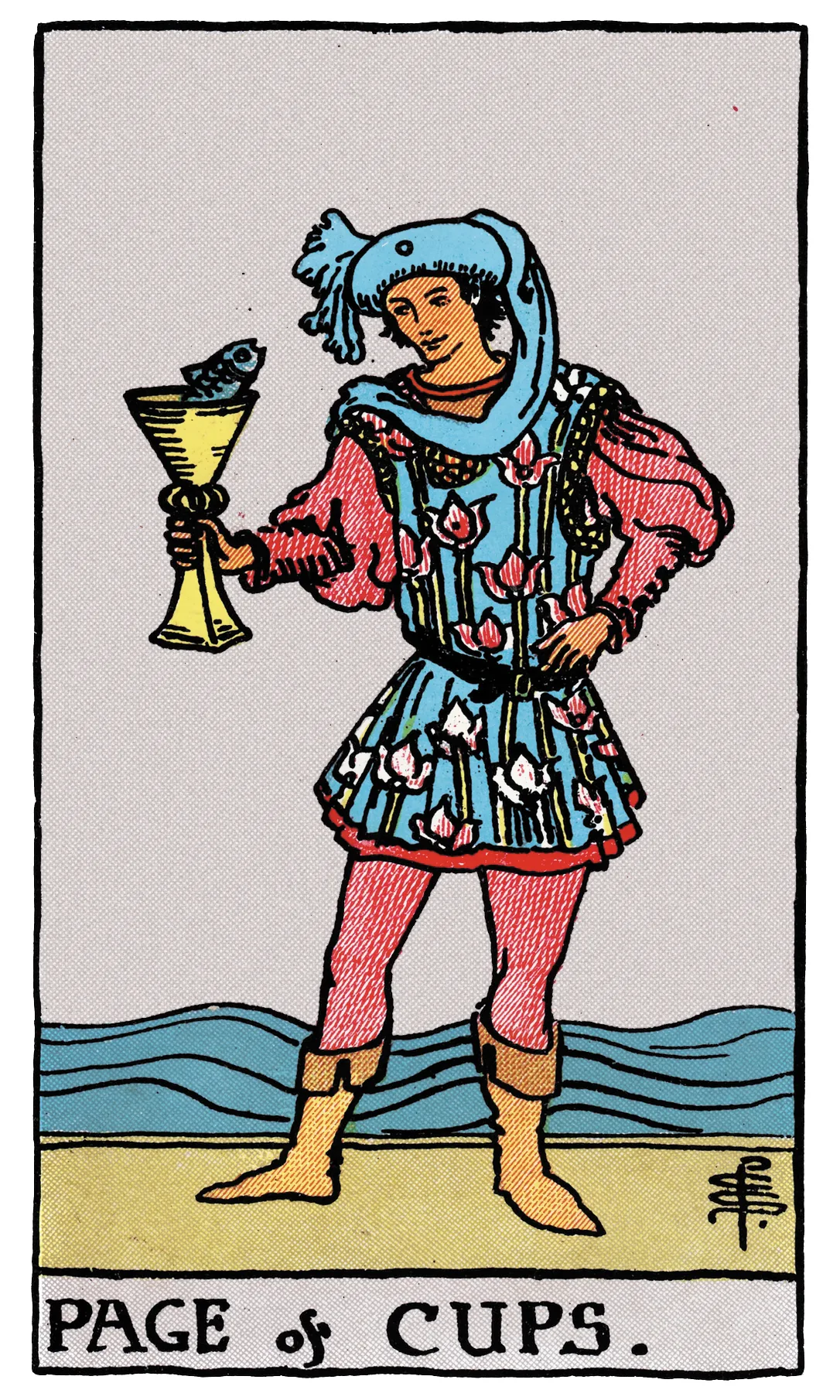
The Page of Cups is the Tarot's dreamer, the gentle figure who stands at the boundary between imagination and reality with an expression of perpetual wonder. In the Rider-Waite-Smith image, a young person in a floral tunic and beret stands by the sea, holding a golden cup from which a small fish unexpectedly emerges. The figure gazes at the fish with curiosity rather than alarm, accepting this impossible visitor as if such things were perfectly natural. A flowing scarf moves gently in the breeze. The entire scene radiates a quality of innocence that is not naivete but openness, the willingness to be surprised by what the unconscious delivers. As Earth of Water, the Page represents the tangible manifestation of emotional beginnings: the first poem, the first crush, the creative impulse that arrives unannounced and changes the quality of a day. The Page does not yet know where these feelings will lead. That uncertainty is not a problem. It is the point.
At a Glance
| Attribute | Detail |
|---|---|
| Suit | Cups |
| Traditional Names | RWS: Page of Cups · TdM: Valet of Cups · Thoth: Princess of Cups |
| Element | Water |
| Zodiac / Planet | Earth of Water · Rules a quadrant rather than a zodiacal range |
| Upright Keywords | creative inspiration, intuitive message, inner child, new emotion, dreamer, gentle soul |
| Reversed Keywords | emotional immaturity, escapism, blocked creativity, insecurity, unrealistic, seduction |
Free printable chart: see the complete Minor Arcana chart · all 56 cards with upright and reversed meanings, suit, and element at a glance.
Visual Traditions: Three Decks
The Minor Arcana's imagery varies significantly across the three major traditions. Understanding these differences deepens your reading of any deck.
Rider-Waite-Smith (1909) · The image shown above.
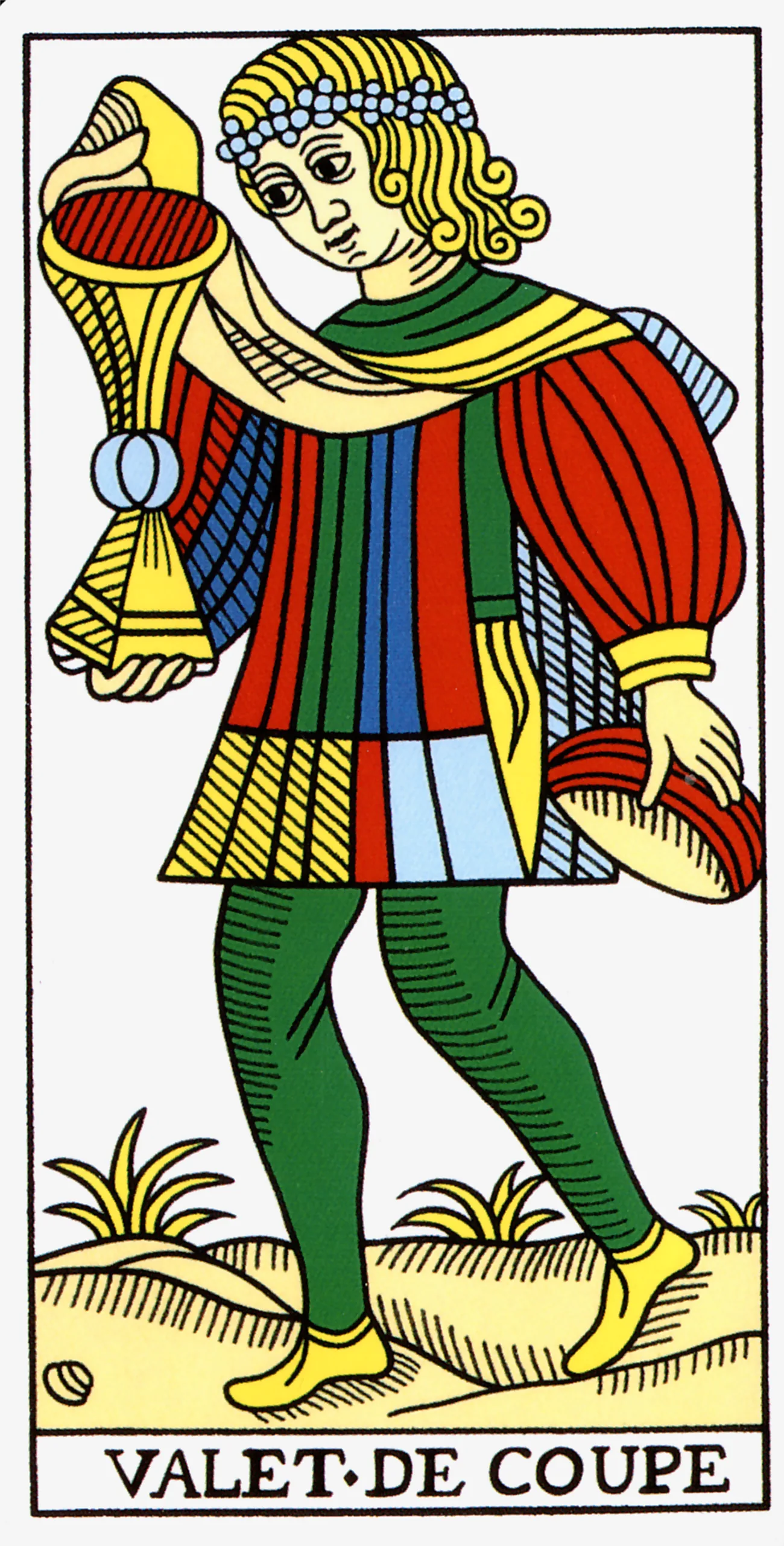
Tarot de Marseille (17th-18th century) · The Marseille Valet of Cups presents a young attendant standing with a chalice, often holding it with an air of gentle formality. The figure's posture suggests readiness to serve rather than command, and the cup is displayed with careful attention, as if its contents are precious and require delicate handling. Without the RWS fish emerging from the cup, the TdM valet emphasizes the courtly role of emotional service: the young person who carries messages of the heart, who mediates between feeling and social obligation. The clothing is typically ornate but youthful, conveying a beginner's relationship to the emotional world, someone who knows the forms of courtesy but has not yet been tested by the depths that true feeling demands.
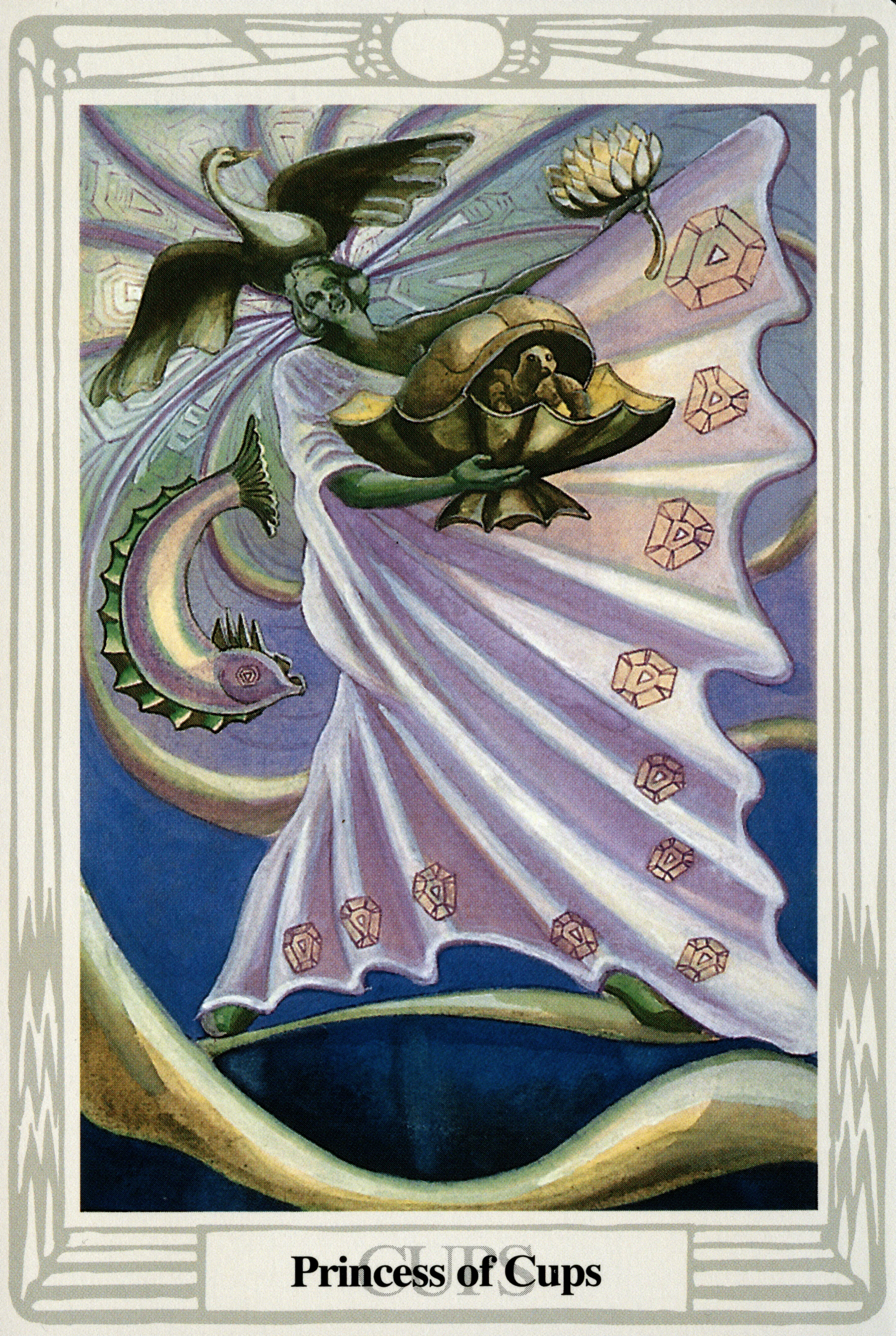
Thoth Tarot (1943) · Crowley's Princess of Cups is a figure of ethereal beauty rising from or hovering above a calm sea. She holds a cup from which a turtle or tortoise emerges, surrounded by crystalline formations and iridescent foam. The background is luminous with pale blues, greens, and translucent pinks. Harris painted the card as a vision of emotional potential in its most delicate and receptive state. The Earth-of-Water attribution gives the Princess her particular quality: she is the grounding force within the emotional realm, the vessel through which formless feeling first takes tangible shape. The turtle symbolizes patience, protection, and the slow emergence of deep emotional content into conscious awareness. The Princess is not rushing toward love or inspiration. She is allowing it to surface at its own pace.
Key Imagery and Symbolism
The fish emerging from the cup is the card's defining image and its most psychologically rich symbol. Fish live beneath the surface of consciousness, in the deep waters of the unconscious mind. When one rises into the cup, a vessel held in conscious hands, it represents an intuitive message, a creative impulse, or an emotional truth surfacing from depths the conscious mind cannot access on its own. The Page's reaction to this visitor is crucial: there is no fear, no rejection, no attempt to analyze. Simply quiet fascination, the response of someone who trusts the imagination's offerings. The floral tunic connects the Page to the natural world's patterns of growth and bloom, suggesting that emotional development follows organic rhythms rather than calculated schedules. The beret marks the figure as something of an artist, someone who inhabits the creative margins rather than the conventional center. The sea in the background represents the vast emotional and unconscious realm from which the fish has come, and to which it will return. The Page stands at the shore, the liminal space between solid ground and deep water, between the known and the unknown, between what can be controlled and what can only be received · a threshold that Jungian Tarot work explores as the encounter between ego and the unconscious.
What Page of Cups Means
Upright
When the Page of Cups appears upright, it signals a creative or emotional message arriving from an unexpected source. Inspiration strikes without warning. A gentle offer of love or friendship appears in your life. An intuitive hit proves accurate. The Page carries the energy of beginnings: the first flutter of attraction, the first line of a poem, the first dream that refuses to be forgotten. In practical readings, the Page often represents a young person, or the youthful aspect of any person, who approaches emotional life with curiosity, openness, and a willingness to be surprised. This figure is not calculating or strategic about feelings. They simply feel, and their honesty is both their gift and their vulnerability. In creative contexts, the Page of Cups is one of the most encouraging cards, suggesting that inspiration is available if you are willing to approach your work with the beginner's mind that this figure embodies. The fish in the cup will only appear if you hold the cup without expectations. In relationship readings, the Page indicates a tender, sincere emotional offering, sweet and genuine if somewhat inexperienced.
Reversed
Reversed, the Page of Cups suggests emotional immaturity, creative blockage, or the misuse of emotional sensitivity. The dreamer's qualities that are so charming upright become problematic when reversed: escapism replaces imagination, sentimentality replaces genuine feeling, and the refusal to grow up replaces the freshness of youth. The reversed Page may indicate someone who uses emotional vulnerability as a manipulation tool, performing sensitivity to gain sympathy or avoid responsibility. In creative contexts, the reversal points to a block: the fish is not appearing, the cup feels empty, and inspiration has dried up. This creative drought is often connected to emotional issues, a fear of vulnerability, a past rejection that made you close the door to new offerings, or the cynicism that accumulates when too many beginnings lead nowhere. The reversed Page can also indicate an unwillingness to take emotional risks. The upright Page holds the cup open and accepts whatever emerges. The reversed Page keeps the cup covered, afraid of what might surface from the unconscious. The remedy is usually the simplest possible creative or emotional act: write one line, send one message, allow one feeling to exist without trying to control it.
How Position and Surrounding Cards Shift the Meaning
The Page of Cups takes on different textures depending on its neighbors. Paired with the Ace of Cups, the emotional message is a genuine new beginning of love or creative life. Near the Seven of Cups, the Page's dreamy quality tips toward escapist fantasy. With the Magician, the creative impulse finds its channel: imagination backed by skill and will. Beside the Three of Swords, the Page's emotional openness encounters painful truth, and the question becomes whether innocence can survive the encounter with heartbreak.
Suit Element: Cups
As Earth of Water, the Page of Cups represents the most tangible, grounded expression of emotional energy: feelings that take form, creative impulses that become visible, intuitive messages that arrive as concrete images or experiences. The Page is the element of Water finding its first solid footing, the moment when an emotion stops being abstract and becomes something you can hold, name, and share. In Kabbalistic terms, the Pages correspond to Malkuth (Kingdom), the final manifestation, within their suit's world. The Page of Cups is feeling made real: the tear, the smile, the first brushstroke of a painting that began as an unnamed inner stirring.
Numerology
As the first court card, the Page represents the beginning of emotional personality: the aspect of self that approaches feeling with wonder, curiosity, and the willingness to be surprised. In the court card progression from Page through King, the Page is the student of the heart, learning about love, creativity, and intuition through direct, unfiltered experience rather than theory or strategy.
Page of Cups in Love, Work, and Health
Love and Relationships
In love readings, the Page of Cups represents the tender first stirrings of romantic feeling: a crush, a sweet message, a gentle invitation to explore emotional connection. This is not the passionate charge of the Knight of Cups or the deep commitment of the King of Cups but the innocent, curious phase where everything feels new and nothing is yet complicated. For singles, the Page suggests that a romantic interest is approaching, or that your own emotional openness is creating the conditions for love to arrive. For couples, the card indicates a return to tenderness and playful affection. Reversed, it may signal emotional immaturity in a partner or the tendency to confuse infatuation with genuine connection.
Career and Finances
For career questions, the Page of Cups represents creative inspiration, the beginning of an artistic project, or a workplace environment where emotional intelligence and imagination are valued. The card often appears when someone is considering a creative career path or discovering that their professional strengths lie in empathy, intuition, and the ability to communicate feeling. It can also indicate a message about a creative opportunity: an invitation to submit work, a compliment on an artistic project, or an unexpected opening in a field that engages the heart. Reversed, creative blocks, professional insecurity, or the sense of being too sensitive for a harsh work environment may be issues.
For students exploring the court cards in depth, Linda Marson's course Cracking the Court Card Code decodes the personality system of the sixteen court cards, revealing how each figure embodies a unique combination of element and rank.
Health and Wellbeing
In health readings, the Page of Cups connects to the healing power of creative expression and emotional honesty. Art therapy, journaling, dream work, and any practice that gives form to inner experience can be particularly beneficial now. The Water element links to emotional health, the immune system, and the body's fluid systems. The Page's youth suggests that the body has reserves of healing capacity that are activated when emotional expression is allowed. Reversed, suppressed emotions or creative frustration may be manifesting as physical symptoms, particularly in the throat, chest, or digestive system.
Card Pairings and Relationships
Every Minor Arcana card takes on different dimensions depending on its neighbours. These pairings are not fixed rules but starting points for interpretation.
Page of Cups + Ace of Cups: Pure emotional beginning. The Ace's divine offering meets the Page's open receptivity, creating a reading of fresh love, new creative life, or spiritual awakening arriving with childlike grace.
Page of Cups + The Magician: Inspiration meets skill. The Page's creative impulse finds the Magician's focused will, transforming a dreamy idea into a real creation. The artist who knows their craft.
Page of Cups + Seven of Cups: Dreaming too far. The Page's healthy imagination tips into the Seven's escapist fantasy. Discernment is needed to distinguish genuine inspiration from wishful thinking.
Page of Cups + Three of Swords: Innocence meets pain. The Page's emotional openness encounters the Three's heartbreak, testing whether the dreamer can survive disillusionment without losing the capacity for wonder.
Page of Cups + Queen of Cups: Student and master of emotional life. The Page's nascent emotional wisdom finds its mentor in the Queen's deep intuitive maturity. A relationship of emotional growth.
Page of Cups + The Star: Inspired hope. The Page's creative curiosity aligns with the Star's spiritual renewal, creating a reading of genuine artistic and emotional breakthrough.
Page of Cups + Six of Cups: Childhood wonder renewed. The Six's nostalgic innocence resonates with the Page's childlike emotional energy, suggesting a return to the creative freedom of youth.
Page of Cups + Knight of Cups: Emotional progression. The Page's gentle curiosity evolves into the Knight's romantic quest, showing the development from first feeling to active pursuit.
Page of Cups + The Moon: Imagination deepened by mystery. The Moon's dreamlike quality amplifies the Page's intuitive receptivity, creating a reading rich in psychic impressions and creative visions.
Page of Cups + Ten of Pentacles: Creative talent within a family legacy. The Page's artistic gifts may be connected to family heritage, inherited talent, or the support of a stable material foundation.
Related Cards
- Ace of Cups · The Ace provides the raw emotional material that the Page encounters: both represent beginnings, but the Ace is the gift while the Page is the receiver.
- Knight of Cups · The Knight represents the Page's next developmental stage: emotional curiosity becoming romantic pursuit, gentle wonder becoming passionate quest.
The Star · Both cards embody gentle, hopeful emotional energy. The Star guides the Page's creative journey with spiritual light and quiet encouragement.
Queen of Cups · The Queen is the mature expression of the Page's emotional gifts: what begins as innocent receptivity deepens into profound intuitive wisdom.
- Six of Cups · Both cards carry childlike emotional energy. The Six revisits childhood through memory; the Page embodies it as a living quality of openness.
Seven of Cups · The Seven shows the danger of the Page's imagination ungrounded: dreaming that never connects to reality, creativity that never takes form.
The Magician · The Magician can channel the Page's raw creative impulse into deliberate creation, providing the skill and focus that innocent inspiration requires.
- Page of Swords · Both Pages represent youthful energy, but Cups leads with feeling while Swords leads with thinking. Together they show the two faces of young curiosity.
- The Moon · The Moon deepens the Page's intuitive gifts into psychic receptivity, but also warns that not every message from the unconscious is reliable.
Explore the Minor Arcana Further
Page of Cups is one of 56 cards in the Minor Arcana, and its meaning deepens when read alongside the cards that surround it. If you are drawn to the practical and psychological dimensions of the Tarot, these courses offer a guided path from first reading to professional skill.
Recommended courses:
- Client-Centred Readings · Professional skills for Tarot readings that truly serve the client · Taught by Linda Marson
- Reading Tarot Reversals · Twelve methods for reading reversed Tarot cards · Taught by Mary K. Greer
For the complete guide to all 56 Minor Arcana cards, visit The Minor Arcana: Complete Guide.
For a comprehensive introduction to reading all 78 Tarot cards, see How to Read Tarot Cards: A Complete Guide.
Go deeper · explore our Tarot courses with Mary K. Greer, Rachel Pollack and more.