Tarot and Intuition
with Mary K. Greer
Every Tarot reader has experienced it: you turn over a card and something clicks before you even think about it. A feeling, a word, a sudden certainty. Then the analytical mind steps in and the moment is gone. You start second-guessing. Was that real insight, or just a lucky guess?
In this recorded class, Mary K. Greer, one of the most respected Tarot teachers in the world, takes you inside the science of that first impression. Drawing on Daniel Kahneman’s research on fast and slow thinking, over 150 years of scientific studies on intuition, and her own fifty years of reading experience, Mary reveals what intuition actually is (and what it isn’t), why it’s roughly 50% accurate on its own, and how to use practical techniques to make it dramatically more reliable.
This is not a class about “trusting your gut.” This is a class about understanding it.

Most intuition courses tell you to trust yourself. This one shows you where that trust is well-placed · and where it leads you astray.
What Students Are Saying
What’s Inside
Everything You Need to Understand and Sharpen Your Intuitive Reading

One In-Depth Video Class
About ninety minutes of recorded instruction where Mary walks you through the neuroscience of intuition, the difference between intuitive and psychic perception, Daniel Kahneman’s System 1 and System 2 framework applied to Tarot, and hands-on exercises you do with your own cards during the class. This is practical psychology for card readers, taught by someone who has been doing it for over fifty years.

Four Guided Exercises
This is not a lecture you passively watch. Mary includes four interactive exercises that you do in real time with your own Tarot deck: a centering and visualization practice, a peripheral vision technique for shifting your perception, a three-card reading scenario that reveals your hidden biases, and a homework assignment designed to put everything into practice with a real reading partner.

A Framework for Honest Reading
The most valuable part of this class is something most Tarot courses never address: the hidden biases that shape every reading you give. Mary teaches you to recognize cognitive dissonance, the discomfort that arises when cards conflict with your beliefs, and provides specific techniques for working with it instead of letting it take over. This framework transforms not just your readings, but how you understand yourself as a reader.

Subtitles in 11 Languages
Every lesson includes professionally translated subtitles in English, German, Spanish, French, Italian, Japanese, Korean, Portuguese, Russian, Vietnamese, and Chinese. Whether English is your second language or you simply prefer reading along, you can follow Mary’s teaching in the language most comfortable for you.
Your Practice
What You'll Learn
Foundation
What Intuition Actually Is
Mary draws a clear line between intuition and psychic ability, two things most people blur together. Intuition is a natural brain function everyone uses, based on subconscious pattern recognition from sensory input, memories, and emotions. Psychic ability (ESP) operates without any sensory information at all. Understanding this distinction changes how you evaluate your own readings and how honestly you can assess what’s working.
Core Framework
System 1 and System 2 for Tarot Readers
Drawing on Nobel laureate Daniel Kahneman’s research, Mary maps the two modes of thinking directly onto Tarot practice. System 1 is fast, intuitive, and emotional: your first impression when a card appears. System 2 is slow, rational, and rule-based: traditional meanings, correspondences, and keywords. The best readings, Mary argues, combine both. She shows you exactly how to do that.
Applied Psychology
Recognize and Work with Cognitive Dissonance
When two cards seem to contradict each other, something happens inside you before you say a word. You feel the pull to “fix” the conflict, to rush past discomfort, to impose a resolution. Mary calls this out directly and teaches you to notice it, sit with it, and use it. Her three-possibility technique (worst case, best case, middle road) breaks the grip of binary thinking and opens readings to possibilities you would otherwise miss.
Practical Techniques
Concrete Methods to Sharpen Every Reading
Turn statements into questions. Use peripheral vision to shift your perception. State your biases out loud to release them. Go meta by focusing on goals instead of solutions. Mary gives you over a dozen specific, practicable techniques you can use immediately, whether you read for yourself or for others.
Heart of the Course
Read with Your Eyes Open
Most courses on intuition tell you to “trust yourself.” Mary tells you something more honest and more useful: trust yourself, and know exactly where your biases lie. When you understand how confirmation bias, cognitive dissonance, and intersubjectivity shape every reading, you don’t become less intuitive. You become a reader who can rely on their intuition because they understand where it comes from and where it might lead them astray.
What Students Are Saying
Who This Course Is For
If you’ve ever second-guessed a reading or rushed past a difficult card to keep your querent comfortable, this class will show you exactly why · and give you practical tools to work with it.
Free companion resource: keep our free Major Arcana chart beside you as you study · a printable reference to all 22 cards.
- Readers who know the cards but want to understand themselves · you can do a reading, but you want to know how much of it is genuine insight versus unconscious bias.
- Anyone tired of being told to “just trust yourself” · you want something grounded in actual research about how the brain makes snap judgments, not mystical platitudes.
- Professional or aspiring professional readers · you read for others and want to be honest about where the cards end and your own projections begin.

Course Outline
From the neuroscience of intuition to cognitive dissonance in real-time readings, with four interactive exercises and a homework assignment to put everything into practice.
The Science of First Impressions in Tarot (about 90 min)
Intuition vs. Psychic Ability · The Intuition-ESP Continuum · Subconscious Pattern Recognition · Daniel Kahneman’s System 1 and System 2 · Neural Pattern Formation · Confirmation Bias · Cognitive Dissonance in Readings · Intersubjectivity and Mirror Neurons · Empathy in Tarot Practice · Three-Possibility Technique · Peripheral Vision Exercise · Heuristic Checkpoints · Turning Statements into Questions · Going Meta
Mary opens by distinguishing intuition from psychic ability, placing them on a continuum rather than as separate categories. She defines intuition as “an immediate cognition without the use of conscious rational processes,” rooted in subconscious sensory input and neural pattern recognition, and supported by over 150 years of scientific research. She contrasts this with ESP (extrasensory perception), sharing a vivid personal story about knowing her husband had been in a car accident before answering the phone.
The class then introduces Daniel Kahneman’s System 1 (fast, intuitive, emotional) and System 2 (slow, rational, rule-based), showing how the best Tarot readings combine both modes. Mary demonstrates that pure intuitive reading without any knowledge checkpoints is roughly 50% accurate, and that traditional meanings, correspondences, and keywords serve as heuristic checkpoints that dramatically improve reliability.
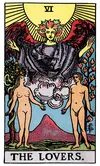
The heart of the class is cognitive dissonance: the discomfort that arises when cards, beliefs, or moral judgments conflict during a reading. Through the affair scenario exercise (The Lovers, Three of Swords, Six of Cups), Mary shows how readers’ biases shape their interpretations in real time, and teaches the three-possibility technique (worst case, best case, middle road) as a concrete method for breaking out of binary thinking. She addresses spiritual bypass in Tarot, the tendency to rush past difficult cards, and teaches readers to “hold space” before offering solutions.
The class concludes with practical techniques for developing intuition: centering and breathing, peripheral vision reading, awareness of cognitive dissonance, using figurative language and metaphor, turning statements into questions, and deliberately stating biases to release them.
Your Guide
Meet Your Instructor

- Lifetime Achievement Award
- Published Author
- 50 Years of Practice
- M.A. English Literature
Mary K. Greer
Tarot Scholar & Author
For over fifty years, Mary K. Greer has been one of the most influential voices in Tarot. Her groundbreaking book Tarot for Your Self started the self-reading revolution, and her published works have shaped how an entire generation approaches the cards. She spent fifteen years teaching Tarot at the college level and co-taught with Rachel Pollack at the Omega Institute for over three decades.
Enroll Now
Payment Plan
- ~90 minute video class with Mary K. Greer
- 4 interactive exercises you do on your own
- The cognitive dissonance framework for honest reading
- Translated subtitles in 11 languages
- Access to the community discussion forum
- Lifetime access to all course materials
- 30-day satisfaction guarantee
Launch Price
3 monthly payments of
$29
$19
10% of your enrollment supports student scholarships
Full Payment
- ~90 minute video class with Mary K. Greer
- 4 interactive exercises you do on your own
- The cognitive dissonance framework for honest reading
- Translated subtitles in 11 languages
- Access to the community discussion forum
- Lifetime access to all course materials
- 30-day satisfaction guarantee
Launch Price
$79
$39
10% of your enrollment supports student scholarships
Study Without Hesitation
Frequently Asked Questions
Do I need any experience with tarot to take this course?
Some familiarity with Tarot is helpful. Mary references specific cards (The Lovers, Three of Swords, Six of Cups, Five of Cups, Five of Pentacles) during exercises and demonstrations. You don’t need to be an expert, but knowing what the Major Arcana are and having a basic sense of card imagery will help you follow along. She recommends having a Rider-Waite-Smith deck or one influenced by it.
How long is the course?
One recorded video class, about ninety minutes. The class includes four interactive exercises that you do in real time with your own cards.
What exactly will I learn to do?
You’ll learn to distinguish between intuitive and psychic perception in your readings, recognize when cognitive dissonance is distorting your interpretations, use the three-possibility technique to break out of binary yes/no thinking, and apply over a dozen practical methods to sharpen your intuitive accuracy. This is a framework course: it changes how you think about every reading you do, not just one technique.
Is this a "psychic development" course?
No. Mary explicitly separates intuition from psychic ability and focuses entirely on the intuitive side. She approaches intuition as a natural brain function supported by neuroscience research, not as a mystical gift. If you’re looking for a science-grounded approach rather than a metaphysical one, this is the class for you.
I’ve been reading tarot for years. Will I still get something from this?
Experienced readers often get the most from this class. The cognitive dissonance framework, in particular, applies to patterns that experienced readers have developed over years of practice. Mary specifically addresses the “spiritual bypass” tendency that many seasoned readers have: rushing past difficult cards to offer comfort rather than acknowledging what the cards actually show.
Is there a community or forum where I can discuss what I’m learning?
Yes. Every course includes access to the Global Spiritual Studies community forum, where you can share your experiences with the exercises, discuss cognitive dissonance in your readings, and connect with other students. Mary originally encouraged live participants to continue discussing their experiences in the forum, so you’ll be carrying on that tradition.
How does the payment plan work?
Choose the payment plan option at checkout and pay in three monthly installments of $19 (on sale from $29). You get full access to the course immediately with your first payment. Subsequent payments are charged automatically each month.
Do you offer scholarships?
Yes. 10% of every purchase supports the Global Spiritual Studies Scholarship Fund. If financial circumstances make it difficult to enroll, we encourage you to apply. The application takes just a few minutes.
What if I don’t enjoy the course?
We offer a 30-day satisfaction guarantee. If the class isn’t right for you, contact us for a full refund. No questions, no conditions.
How long do I have access to the course?
Lifetime access. The recorded class and subtitles are yours to revisit whenever you like. Many students find the cognitive dissonance framework becomes more valuable over time as they notice new patterns in their own reading practice.
What Students Are Saying
Community
Scholarships Available
10% of every course purchase goes directly to the Global Spiritual Studies Scholarship Fund. This material should be available to anyone drawn to it, regardless of financial circumstances.
If you’d like to apply for a scholarship, the process is simple, confidential, and takes just a few minutes.