Key and Anchor
Key and Anchor is the pair people draw when they want to know whether something will hold, and the order decides whether the answer fastens a thing or explains it. Put the Key first and the subject becomes the solution, with the Anchor supplying its character: what resolves this is something durable rather than something clever, an arrangement you can put weight on. With the Anchor leading, what is already fixed becomes the subject and the Key makes it decisive, which is where the published entries put perseverance producing a breakthrough and, in the same breath, finally understanding what has been holding you in place. Both directions are favourable. The useful question is not whether, but which: is the answer to fasten something, or to see what is already fastened?
- Key + Anchor (33 + 35)
- The solution is the subject and durability describes it. What settles the matter is a lasting arrangement: a commitment, a fixed point, a thing that will still be there next year.
- Anchor + Key (35 + 33)
- What is already stable is the subject and the Key makes it definite. Endurance turning into the breakthrough, or the constraint you have been circling finally being named.
- The cards
- Key · card 33 · 8 of Diamonds · positive. Anchor · card 35 · 9 of Spades · positive.
- Yes or no
- Yes both ways, and among the deck's firmest. Certainty comes from the Key and duration from the Anchor, so the answer tends to be yes and it tends to last.
- Timing
- The second card governs the pace, and the two orders run at opposite speeds. Key + Anchor takes the Anchor's long patient count. Anchor + Key takes the Key's, which most lists put at soon and definite.
The two cards
The Key is the deck's card of certainty. Solution, resolution, discovery, destiny, the thing that matters most: whatever it stands beside becomes definite. What gets forgotten is that a key turns both ways. One well-used English reference lists both what needs opening and what needs locking away among its meanings, so the card can name the thing being sealed as readily as the thing being released, and knowledge held back counts as certainty every bit as much as an open door does.
The Anchor is stability, perseverance, work and harbour, with being stuck as its shadow. The Lenormand Reader describes it as "stability we have already achieved", which is the crucial tense: the Anchor reports something that is already the case rather than something being promised. Among the Lenormand cards it is the one most often mistaken for a forecast when it is really a description.
So this is a pair of two positives that both have a second face, and the second faces are what make it interesting. In the directional method used on this site, we read the first card as the subject and the second as its modifier. Here that decides whether you are being told the answer or being shown the anchor chain.
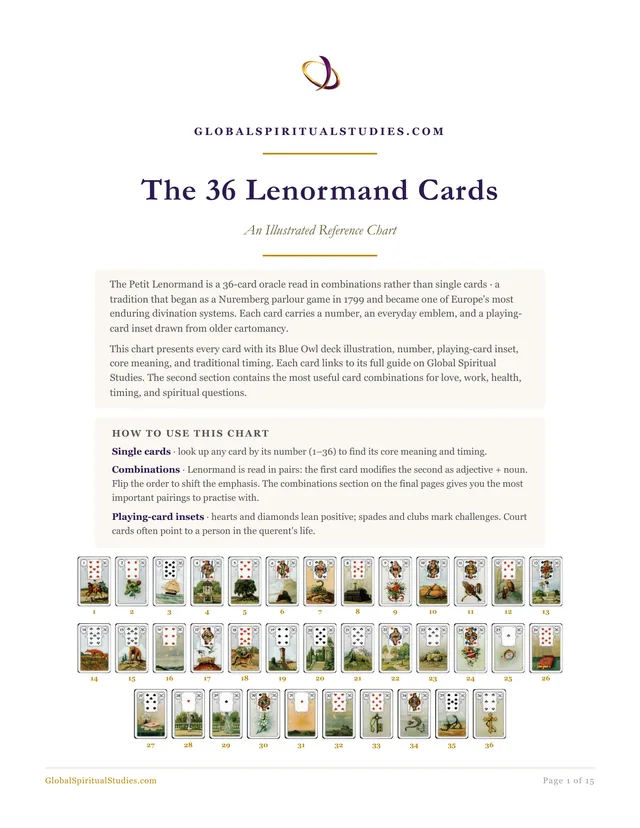
Favourable pairs are the ones readers skim, which is exactly when a second meaning gets missed. Our free 36-card Lenormand chart carries every card's keywords, polarity, playing-card insert and Grand Tableau house on one printable page, so the quieter half of a card's range stays in front of you.
Key + Anchor
The Key leads, so the solution is the noun. Something resolves, and the Anchor supplies the adjective: lasting, settled, immovable. The sentence is an answer with weight in it. Not a clever manoeuvre and not a temporary fix, but the kind of resolution that is still true a long time afterwards.
Boswell's entry for this order runs exactly that way: a notable result, access to safety, being open to a more stable option, and agreeing to something permanently. The last of those is the one worth pausing on, because permanence is the price as well as the prize. If what resolves the situation is a fixed arrangement, then a fixed arrangement is what the person is left holding, and the pair is describing the shape of that without recommending it.
This is the order to expect when somebody wants to know whether a matter will finally settle: the answer is that it will, and the settling itself is going to take the shape of a commitment rather than a resolution in the abstract.
Anchor + Key
Reverse them and the fixed thing becomes the noun. Something is not moving, and the Key describes it: certain, decisive, important. That produces two readings which look opposite and are the same grammar.
The first is perseverance paying. Boswell's entry for this order is important consistency and persistence leading to a breakthrough, and that is the Key confirming what the Anchor has been doing all along: the long steady effort turns out to be the thing that unlocks it. Her list also, delightfully, arrives at secure passwords, which is either a scandal for the deck's card of destiny or a sign that the literal register is alive and has to point at something modern.
The second is diagnosis. Anna.K's entry for this order includes understanding what confines us and the conflict between wanting to break free and being tied down, and Labyrinthos, in the single line it prints for the pair, has understanding what holds us. Here the Key is not opening the situation; it is naming the thing that has been holding it. That reading appears in the field's own entries and almost nowhere in the summaries built on top of them.
So the two directions genuinely differ. Key + Anchor gives you an answer that happens to be durable. Anchor + Key tells you the durable thing is the answer, which is good news when it is perseverance and a harder piece of news when it is the chain.
The pair across five areas of life
| Area | Key + Anchor | Anchor + Key |
|---|---|---|
| Love | The resolution takes the form of settling: moving in, formalising, or simply the question stopping being a question. Certainty arriving as permanence. | A long relationship reaching a decisive point, or the thing that has actually been keeping two people together finally being said out loud. Not always comfortable, usually clarifying. |
| Work | An answer that arrives as a permanent arrangement: a contract rather than a project, a post rather than a piece of work. The oldest written meaning of card 35 is trade, which fits this order well. | Long service producing the opening. Also the reading where somebody sees precisely what has kept them in a role, which is information whether or not they act on it. |
| Money | Money that stops moving: a term fixed, an income made regular, an arrangement locked in. The pair describes the shape and not whether the terms are good, which is a matter for the people signing them. | Steady effort delivering a definite result, and the reading in which a standing obligation is finally named for what it is. What to do next is a call only the account-holder can make. |
| Health | A durable answer rather than a quick one: a regimen, a routine, something maintained. The cards describe circumstances here, and anything clinical is a conversation for a qualified professional. | Persistence rather than a single event, and the naming of a long-standing factor. Again, this describes a situation rather than diagnosing one. |
| Timing | Pace here follows the Anchor, since it is second: thirty-five, a long reliable count, developing through patient effort rather than arriving. | Now it follows the Key instead, and the Key is the deck's promptest card. Most lists put it at soon and definite, with the 3rd of the month as its date, so this order is quick where the other is slow. |
Key and Anchor in the Grand Tableau
Adjacent, this pair is one of the tableau's steadying influences, and the card beyond it decides what is being steadied. Key, Anchor and Ring is an agreement about to be made permanent. Key, Anchor and Mountain is a definite answer that then meets resistance, which is a considerably more sober line than either of the first two cards suggests.
Distance behaves differently here than it does with the difficult pairs. Two favourable cards several positions apart are simply describing two good things in different parts of the picture, and there is no temptation to invent a link, which is why this pair gets under-read in a full tableau rather than over-read.
The houses put the question sharply. House 33 asks what the answer is, so the Anchor landing there says the answer is to hold: continue, endure, do not change course. House 35 asks what is stable, so the Key landing there says the stable thing is the important one, which can be a compliment to a person's foundations or a note about what is not moving. Finding both is a tableau arguing for patience with unusual conviction.
Worth setting apart from card meaning entirely: this deck began life as a parlour board game around 1800, and its rule sheet is almost entirely about play. It does close with a short story-telling oracle, laying the cards out in five rows and starting from card 29 for a woman or card 28 for a man, but that method assigns no meaning to any individual card. Under those Game of Hope rules, square 33 hands the arriving player two marks with no strings on it, while square 35 is the finish line itself, called the picture of Hope, and whoever lands there scoops the entire pot. One quirk makes it interesting: a player who overshoots must count backward to correct, yet the rules forbid claiming the pot by counting back, only by advancing onto the square directly. So the Anchor's square could only ever be won moving forward. None of that describes what either card means, but the pattern still catches the eye: a guaranteed small payout two squares from home, and a finish line that punished overshooting.

Where the traditions differ
There is no dispute about whether this pair is favourable. The disagreement, such as it is, concerns what the Key is doing to the Anchor.
Most compilers write it up once and reuse it for both directions. Labyrinthos carries a single identical line on its Key page and its Anchor page, about opening up to setting down roots and understanding what holds us, and that line contains both of this pair's readings without noticing that they are two. Phuture Me gives essential stability and the critical factors that secure a situation, again for the pair as a whole. Neither is wrong; both are compilations organised by card, and a pair written up twice from two card pages tends to arrive as one sentence.
Boswell separates the orders, and the split lands where the grammar predicts. Key first gives a notable result and agreeing to something permanently. Anchor first gives important consistency and perseverance producing breakthroughs. An outcome in one direction, a process in the other. She states no rule about direction, so this is independent corroboration rather than authority.
Anna.K supplies the reading the English summaries lose. Her entry holds the whole ambivalence at once: saying yes to staying put, allowing oneself to hold on to something, understanding what confines us and why, the pull between breaking free and being tied down, and liberation from a routine that has gone dead. That is the same two cards producing both an answer and a diagnosis, which is what a certainty card does when it is pointed at something immovable.
There is also an absence. The Lenormand Reader teaches directionality explicitly and demonstrates it with the Anchor and the Ship, giving arrival for one order and departure for the other, yet carries no entry pairing the Anchor with the Key. The pair falls between two pages that both had room for it.
The oldest written meanings are stranger and better than the modern ones. They come from the instruction sheet of 1846, which a New York paper, The Evening World, reproduced in full on 19 October 1903, and there the Key near the person makes a wish or a plan certain, reversing that verdict once it lies at a distance. Card 35 is not a stability card at all in that sheet: it is a successful enterprise at sea, great advantage in trade, and true love, turning, once far from the person, into a thorough disappointment in one's ideas and inconstancy in love. Commerce and constancy, switched by proximity. The modern Anchor, meaning steadiness in the abstract, is a later distillation of a card that used to name particular good fortunes, and the pair's business register descends from that older sense rather than from anything metaphorical.
This deck has two standard references written by instructors who also teach here, Mary K. Greer and Caitlín Matthews. On the question of directionality for this exact pair her published work is silent, as is Matthews's, so credit for what follows belongs to neither of them. Reading the diagnostic sense into the Anchor-leading order is house reasoning, built from grammar alone.
A reading in three cards
A woman asks what is going to happen with a job she has been doing well for six years without much changing. The line comes out Anchor · Key · Ring.
The steady thing is the subject. The Key says it becomes decisive, and the Ring names the form that takes: an agreement. Read as a sentence, the long service is what unlocks this, and what it unlocks is a binding of some kind. The reading describes the shape of the offer and says nothing about whether it is a good one, which is a question about terms rather than about cards.
Deal the same three as Key · Anchor · Ring and the emphasis moves. The solution leads, durability describes it, and the Ring says the durable answer is a commitment: the resolution to her question is to be tied to something, rather than her existing tie producing a resolution. Same three cards, same six years, and the difference between being rewarded for staying and being asked to stay.
What readers get wrong about this pair
Hearing the Key only as an opening. Half its published range is about what is important, what is certain and what should be kept shut, and the oldest American gloss for it is closer to leverage than to liberation. A pair read as unlocking will miss the order in which the Key confirms rather than releases.
Reading the Anchor as a promise about the future. It reports what is already fixed. That makes it excellent evidence and poor prophecy, and a reading that turns it into an assurance of stability to come has changed its tense.
Assuming the two orders run at the same speed. They run at opposite speeds, and it is the most practical thing this pair has to offer: one direction resolves promptly, the other develops over a long patient stretch.
Taking "a stable solution" as the whole entry. It is the standard gloss and it is accurate as far as it goes. What it leaves out is that the same two cards can be naming the thing that has held somebody in place for years, which is a different piece of news arriving in the same envelope.
Questions about Key and Anchor
What does the Key and Anchor combination mean?
A resolution that lasts. Key first, and the solution takes the subject slot with the Anchor confirming its durability: what settles the matter is a stable arrangement rather than a clever move. Anchor first, and the stable thing takes the subject slot with the Key making it decisive, which covers both perseverance producing a breakthrough and the moment somebody understands what has been holding them in place. Both directions are favourable, and neither promises a particular outcome.
Is the Key and Anchor combination a yes or a no?
Yes, and one of the firmer ones the deck gives. The Key is a certainty card and the Anchor is a duration card, so together they lean toward whatever was asked about happening, and continuing to be true afterward. What it does not do is say whether the person will like the shape of it, because permanence is the mechanism in both orders and permanence is not always the wish.
What changes when you reverse the Key and Anchor combination?
Whether the answer or the anchor is being described. Key first describes a solution and calls it lasting. Anchor first describes something already fixed and calls it decisive, which is why that order carries both the reward for persistence and the recognition of a constraint. Most published lists print a single line for the pair, and that line usually keeps the first reading.
Does the Key and Anchor combination mean being stuck?
It can, and the order is where to look. Being stuck is the Anchor's shadow, and when the Key is applied to it the effect is to make the fixed thing definite rather than to release it. Published entries in more than one language reach the same place, describing this pair as understanding what holds us and as the pull between wanting to break free and being tied down. That names a state of affairs, not a verdict on it, and the surrounding cards decide whether the holding is a foundation or a limit.
How quickly does the Key and Anchor combination play out?
It depends which way round it fell, because whichever card comes second governs the pace here, and these two cards keep very different time. Key + Anchor runs on the Anchor: thirty-five days, weeks or months, a long reliable count in which the thing develops through patient effort rather than arriving. Anchor + Key runs on the Key instead, generally read as soon and definite, with the 3rd of the month attached to it. One direction is among the slowest in the deck and the other among the promptest.
Related combinations
Every pair in the deck is indexed in our Lenormand card combinations guide, where you can look up any two cards together.
Learn Lenormand · explore our Lenormand courses with Mary K. Greer and Caitlín Matthews.
Favourable pairs are where a reader's method is least tested and most often wrong, because agreement between two good cards hides the question of which one is being described. The Complete Lenormand teaches the system underneath the meanings · subject and modifier, neighbours, distance, houses and the full Grand Tableau · so that even a settled pair reads as a specific claim about a specific situation.